




Is your cloud migration journey looking like an adventure that takes days to complete? For enterprises anchored to legacy EDWs on StreamSets-based framework, the answer is too often yes.
What should be a modernization effort instead turns into a costly detour—manual scripts, fragile pipelines, schema drift failures, and a long migration process consisting of frequent manual governance. Each dependency carried forward magnifies complexity, risk, and delay.
In today’s world, those compromises are unacceptable. Boardrooms expect real-time insights. Regulators demand transparent governance. Business leaders want new datasets activated in hours, not months. The path forward cannot be another use case of tactical tool or patchwork of scripts. It requires a framework standard that redefines how data is onboarded, governed, and scaled —especially for enterprises looking to execute their EDW migration to cloud with precision and confidence.
Enterprises are adopting Modak Nabu to escape the trap of StreamSets-based migrations. In a recent migration, a Fortune 500 health insurance provider found StreamSets pipelines multiplying cost, complexity, and risk—and runtimes ballooned when managing large datasets in their migration from Oracle EDW to ADLS.
What was once tolerable in an era when latency was measured in days is a roadblock in a cloud-first enterprise where speed, governance, resilience is non-negotiable. For organizations planning data lake migration or end-to-end modernization, the cracks become clearer and harder to ignore.
Where StreamSets migrations break down
The legacy approach to migration structured workloads into cloud data lakes was never engineered for true scale, resilience, or governance. For many enterprises, moving data from legacy data systems to cloud involve fragile scripts, unstable pipelines, and governance blind spots. What seemed manageable in pilots or small-scale workloads quickly unraveled at enterprise scale. This introduced friction at every stage and multiplied the risk surface —highlighting classic cloud migration challenges:
- Script-based fragility. Data hydration that relied on PySpark scripts executed on APAAS or remote servers had no UI. Monitoring is ad hoc, debugging manual, and even minor changes require code rewrites. In StreamSets, Data Collectors lacked PySpark compatibility, pushing teams toward costlier Transformer upgrades just to support advanced processing.
- StreamSets instability at scale. Pipelines that worked in pilot quickly slowed or failed under enterprise volumes while working with StreamSets, creating backlogs during peak loads, and forcing costly returns.
- Schema drift failures. Frequent changes in source systems broke mappings and transformations. Each incident required manual intervention, delaying downstream data delivery and creating operational bottlenecks.
- No standardized templates. Every ingestion flow was custom-built from scratch. Patterns like DATA-METADATA-RECON had to be re-implemented repeatedly for each new source system, driving up development time and duplicating effort across teams.
- Limited observability. With no centralized dashboards or automated alerting, failures were often unnoticed until reports broke—undermining trust in enterprise data.
- Governance gaps. Authentication was limited to basic username/password schemes, and lineage tracking was inconsistent—slowing audits and exposing compliance risk.
The cumulative impact was clear: onboarding new datasets took weeks, bulk hydration created downtime risks, and engineering teams spent more time firefighting than innovating. These are precisely the gaps that modern cloud migration strategies seek to eliminate.
With Nabu BHPL (Bulk Hydration High Power Low Latency) pipelines, the migration story changes fundamentally. Pipelines are UI-driven, parameterized, and reusable, with Spark-powered concurrency and schema-aware templates ensuring stability at scale. Governance, observability, and error handling are embedded from the start. Instead of brittle, manual pipelines, enterprises can stand up legacy EDW to cloud ingestion in days—repeatable, automated, and trusted.
Introducing Modak Nabu
Modak Nabu is a cloud-neutral, next-generation data platform designed to take the complexity out of large-scale data engineering. It automates the entire lifecycle—from ingestion and profiling to curation and governance—so enterprises can manage petabyte-scale data estates with speed, accuracy, and confidence. By serving as the orchestration backbone of a modern Data Fabric, Nabu eliminates the friction of working across fragmented, distributed datasets and brings them together into a unified, resilient foundation.
Purpose-built for modern architectures, Nabu enables organizations to move beyond stitched-together toolchains toward a single, intelligent control plane. It supports the delivery of domain-aligned Data Products in line with Data Mesh principles, ensuring decentralized ownership without losing centralized oversight. Features such as intelligent ingestion, automated data fingerprinting, dynamic tagging, active metadata cataloging, and collaborative workspaces make it possible to standardize, govern, and operationalize data at scale.
By transforming raw, inconsistent inputs into high-quality, policy-compliant data assets, especially during large-scale EDW migration to cloud or data lake migration initiatives, Nabu positions enterprises to innovate with confidence. It turns data estates into production-ready platforms that can power advanced analytics, AI workloads, and continuous business transformation. With Nabu, organizations gain not just a platform, but a foundation for trusted, future-proof data operations that scale across teams, use cases, and clouds.
Key capabilities include:
- Faster time-to-value: Bulk data onboarding directly into data lakes or Lakehouses with low-latency performance.
- Reusable ingestion templates: Pre-built logic that adapts across domains, reducing repetitive engineering effort.
- Automated schema handling: Pipelines auto-adjust to schema drift, minimizing failures and downtime.
- Operational efficiency: UI-driven design reduces manual scripting and frees engineering teams for higher-value work.
- Deep observability: Dashboards, alerts, and logs provide end-to-end visibility across ingestion pipelines.
- Enterprise governance: Role-based security, lineage capture, and compliance baked into the framework.
- Future readiness: Scales seamlessly with new sources, new volumes, and advanced analytics workloads.
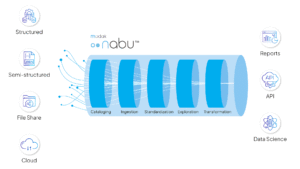
Nabu’s technical edge: Built for scale, speed, and stability
Where StreamSets and script-heavy frameworks struggle to scale, Nabu BHPL delivers stability, performance, and governance as defaults:
- UI-Driven Hydration Pipelines: No more brittle PySpark scripts. Configurations are parameterized and reusable.
- High-Performance Spark Engine: Built-in concurrency handling ensures stability at enterprise volumes.
- Schema-Aware Templates: Auto-refresh pipelines adapt to schema drift, eliminating downtime.
- Observability by Design: Dashboards track status, latency, throughput, and errors—turning pipeline health into an enterprise metric.
- Governance & Security: Integrated with Active Directory, supporting role-based access, lineage tracking, and auditability.
Where StreamSets pipelines took weeks to design, build, and stabilize, Nabu shrinks onboarding to days—without breaking a sweat.
Also Read: Best StreamSets Alternative for Enterprise Data Integration
Modak as the strategic partner: From migration to future-proof strategy
The experience of a Fortune 500 health insurer sends a clear signal: enterprises don’t have to accept the complexity of legacy data platforms. With the right framework and the right partner, cloud migration becomes more than a one-off tactical project—it becomes the foundation for long-term transformation.
As expert cloud migration service providers, Modak delivers:
- Designing and deploying reusable Nabu ingestion templates.
- Migrating high-volume data from legacy source systems with minimal disruption.
- Establishing governance, observability, and operational runbooks for sustainability.
- Providing managed services to monitor, optimize, and evolve the platform post go-live.
The result was a secure, scalable, and future-proof data foundation on ADLS that not only supported current workloads but also created a blueprint for monetization across new use cases and industries.
With Modak as a strategic partner, migration is no longer a one-off tactical project—it is the first step in a long-term transformation. Together, Nabu and Modak are redefining what a data platform can be a complete ecosystem of cloud migration solutions built for enterprises that refuse to compromise on speed, governance, or scale.