




Summary
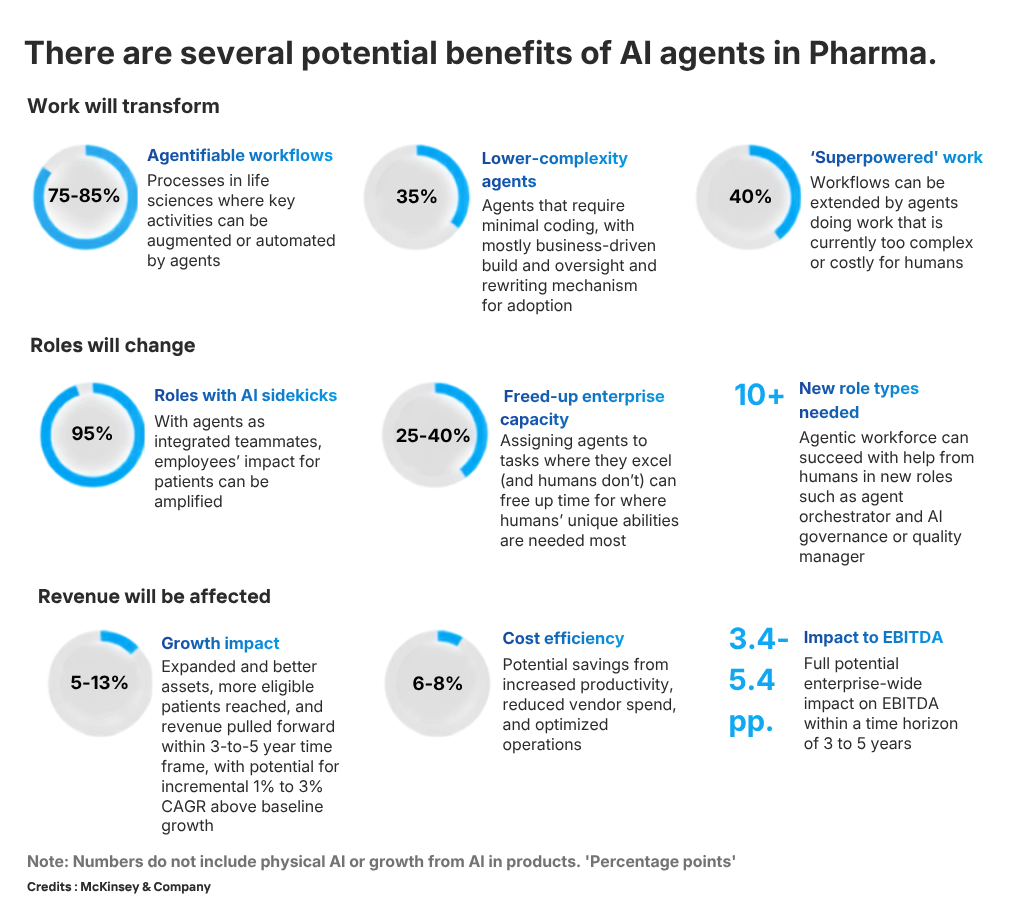
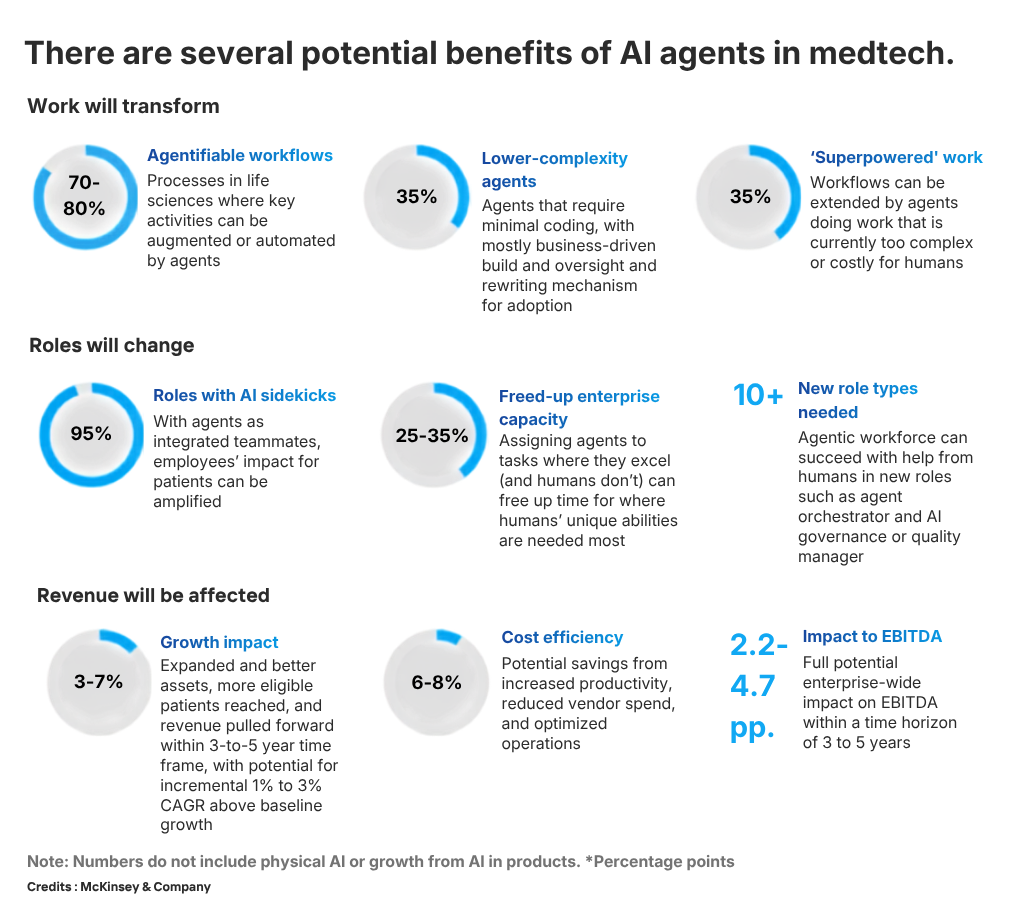
McKinsey’s recent research found that 75 to 85 percent of pharma workflows and 70 to 80 percent of medtech workflows contain tasks that AI agents could automate or enhance, with potential EBITDA gains of 2 to 5 percentage points over three to five years. Yet nearly eight in ten companies already using gen AI report no measurable bottom-line benefit. This piece looks at why that gap exists in regulated life sciences environments, and what actually needs to be true before agentic AI for life sciences produces defensible value at scale.
Life sciences leaders are staring at a strange contradiction. Gen AI adoption is nearly universal. Measurable financial return is rare. The technology isn’t the problem, most enterprise data environments were never built to support it. That is why AI for life sciences initiatives continue to struggle despite rapid advances in foundation models.
We see this constantly in regulated functions: clinical development, biomarker discovery, study onboarding, pharmacovigilance. The gap between a promising agent demo and a defensible, auditable production workflow is where most agentic AI in life sciences initiatives quietly stall.
The Real Bottleneck Isn’t the Agent
Agents are good at pattern recognition, drafting, synthesis, and orchestration across fragmented data. A regulatory-drafting agent can compile submission documents. A trial-design agent can refine protocol structure using benchmarks and simulation. A query-generation agent can flag data anomalies before a human ever sees them. Tasks that used to take a scientist or clinical operations lead days can compress to hours, illustrating the promise of agentic AI in pharma.
None of that matters if the underlying data an agent reasons over is inconsistent, if lineage can’t be reconstructed for an auditor, or if nobody can say with confidence which human approved which decision at which point in the workflow. In life sciences, an agent’s output is only as trustworthy as the evidence trail behind it. And that evidence trail is exactly what most enterprise data environments were never built to produce.
This is the structural problem underneath the adoption paradox. Companies bolt agentic AI in life sciences capability onto data architectures designed for static reporting, not for continuous, auditable, machine-reasoned decision-making. The agent works in the pilot. It stalls at scale because scale requires governance the environment doesn’t have.
What Governed Agentic Execution Actually Requires Agentic AI in Life Sciences
Three things have to exist before agentic AI in pharmaceutical industry produces defensible value in a regulated function:
Structured, provenance-rich data as the foundation
An agent drafting a biologics license application or assembling biomarker evidence across publications and internal reports isn’t just retrieving text, it’s making adjudication decisions about scientific ambiguity. Those decisions need to be versioned, reviewable, and traceable back to source. Without that, you’ve automated a liability, not a workflow. This is a foundational requirement for agentic AI for life sciences.
A clear assurance boundary between automation and approval:
The workflows that actually work in study onboarding, trial design, and clinical data management aren’t the ones where an agent runs unsupervised. They’re the ones where agents handle profiling, mapping, lineage capture, and draft assembly, while sponsors, QA, and platform owners retain approval authority over target-model alignment, exception adjudication, and release gates. The validation subject is a configured workflow for a defined scope, not an open-ended agent making judgment calls a regulator will later ask someone to explain.
Institutional context embedded into execution, not floating in someone’s head
Capacity gains from agentic AI assume agents can access domain rules, business definitions, and architectural standards, the tribal knowledge that today lives in a handful of SMEs, undocumented threads, and legacy code comments. If that context never gets structured, agentic AI plateaus at the pilot stage no matter how sophisticated the model is, because the agent has nothing reliable to reason against. That is one of the biggest barriers to scaling AI for life sciences across regulated enterprises.
Where Agentic AI in Life Sciences Plays Out in Practice
Take clinical data flow. A case report form design agent, an electronic data capture configuration agent, a query generation agent, a data cleaning agent, and a programming agent can work in sequence to dramatically cut database build timelines. That sequence only holds together if lineage is captured at every handoff and mapping decisions are attributable to a human steward when a regulator asks why a field was mastered a certain way.
The same logic applies to study onboarding, where the real work is rarely ingestion, it’s cross-system harmonization and mastering under sponsor control. An agent can profile sources, propose mappings, and draft evidence packages. It cannot, and should not, own target-model alignment or release-gate approval. Sponsors, QA, and platform owners keep that. The value isn’t in removing humans from regulated decisions. It’s in removing the manual grind that keeps humans from getting to those decisions faster. This is where agentic AI in pharma delivers its greatest operational impact.
This is the architecture question underneath every projected growth number in this space. Revenue and margin gains assume organizations can actually operationalize agents against governed data at scale, not just deploy them in a sandbox. Successful agentic AI for life sciences depends on governed execution rather than autonomous automation alone.
The Leadership Question Worth Asking
Scaling agentic AI across R&D, clinical development, or commercial operations is a leadership mandate, not an IT initiative, but the mandate has to come with an honest data-readiness assessment attached to it. The question isn’t which workflows agents can touch. Most of them, it turns out. The question is: can your data infrastructure produce the lineage, structure, and approval trail an agent’s output would need to survive scrutiny? That question becomes even more critical as organizations invest in agentic AI in pharmaceutical industry programs.
For most organizations, the honest answer today is no. That’s not a reason to slow down on agentic AI. It’s the actual starting point, the foundation that determines whether the next few years look like sustained EBITDA gains, or like another cycle of pilots that never left the lab.
Modak ForgeAI is built for this exact gap, embedding institutional context, domain rules, and governed data architecture directly into execution, so agentic workflows in regulated life sciences environments produce evidence, not just output, enabling trusted agentic AI for life sciences at enterprise scale.