



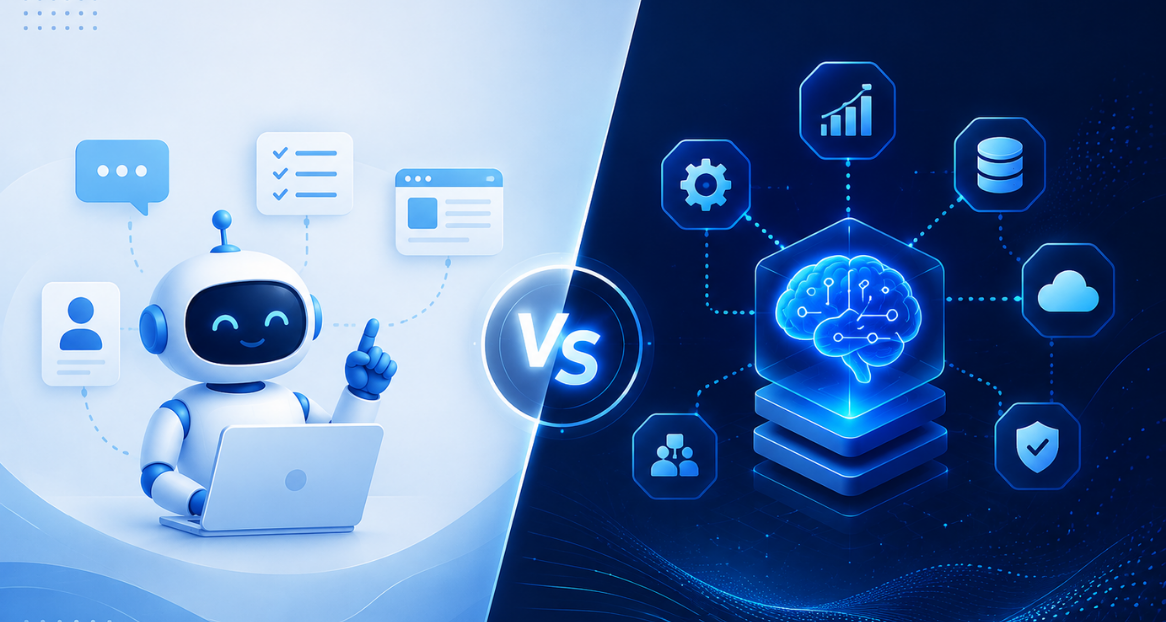
Walk into any enterprise AI roadmap meeting and you’ll hear “agentic AI” and “AI agents” used as if they mean the same thing. They don’t. Conflating the two isn’t just a semantic slip, it leads teams to buy the wrong tooling, staff the wrong roles, and build governance for the wrong layer of risk.
Understanding Agentic AI Vs AI Agents matters because the two sit at different levels of the same stack. One is the architecture. The other is what runs inside it. Get the distinction right, and your planning, procurement, and risk decisions follow naturally. Get it wrong, and you end up governing a system you never actually built, or deploying agents with no orchestration layer to coordinate them.
This piece breaks down the difference between ai agents and agentic ai, walks through how agentic ai works in practice, and gives you a framework for deciding which one your organization actually needs right now.
Agentic AI Vs AI Agents: Starting With the Basics
Before comparing the two, it helps to define each on its own terms. That grounding makes every later claim about Agentic AI Vs AI Agents easier to evaluate against your own stack.
What Is an AI Agent?
An AI agent is a single system built to execute a specific, bounded task. It takes an input, reasons about the next step, calls a tool if needed, and stops once the job is done. Most AI agents today are built on large language models, but their defining trait isn’t the model underneath, it’s the narrow scope of what they’re asked to do.
A support chatbot answering FAQs, a scheduling assistant that books meetings, or a script that summarizes a contract are all AI agents. Each one solves one problem well. None of them are expected to plan across departments, manage a multi-week process, or coordinate with other systems on their own.
This is the component level of the conversation on Agentic AI Vs AI Agents: an agent is a worker, not a workforce.
What Is Agentic AI?
Agentic AI is the broader architecture that gives a system the ability to act with genuine autonomy, planning multi-step work, delegating subtasks, adapting to new information, and pursuing a goal across a sequence of actions rather than a single exchange.
If an AI agent answers “what should I do right now,” agentic AI answers “what does it take to get from here to the outcome, and who or what should do each step along the way.” This is a coordination problem, not just a reasoning one. An agentic system decomposes a goal, assigns pieces of it to individual agents or tools, evaluates the results, and adjusts the plan as conditions change, all with minimal human intervention at each step.
Managing an entire customer support lifecycle from intake to resolution, running a cloud migration end to end, or automating full employee onboarding across multiple systems are all agentic AI use cases. The agents involved might individually be simple, but the system orchestrating them is what makes it agentic.
The Core Difference Between AI Agents and Agentic AI
The clearest way to frame the difference between ai agents and agentic ai is scope plus orchestration:
- Scope: An AI agent has a narrow, well-defined job. Agentic AI pursues a broader goal that gets broken into many connected jobs.
- Autonomy: Agents typically wait for a prompt and stop once they’ve responded. Agentic systems keep moving through a sequence of steps without needing a new instruction after each one.
- Memory: Agents often work with short-term, session-bound context. Agentic AI tends to combine short-term and long-term memory so decisions made in step three still reflect what happened in step one.
- Coordination: An agent works alone. Agentic AI orchestrates multiple agents, tools, and data sources, deciding which one acts next and how their outputs connect.
- Risk profile: Because an agent’s blast radius is small, errors are easy to catch. Because agentic AI chains decisions together, a single wrong step early in the sequence can compound by the time it reaches execution, which is exactly why governance has to be designed at the system level, not bolted onto individual agents after the fact.
None of this makes one option “better” than the other. It makes them the right fit for different problems. The difference between ai agents and agentic ai is really a difference in what layer of the problem you’re trying to solve.
How Agentic AI Works in Practice
At a mechanical level, how agentic ai works breaks down into four recurring stages, regardless of the platform or vendor involved:
- Goal decomposition: The system takes a broad objective and splits it into smaller, sequenced or parallel subtasks.
- Delegation: Each subtask gets routed to the agent, tool, or API best suited to handle it.
- Execution and feedback: Agents act, return results, and the orchestrating layer checks those results against the original goal.
- Adaptation: If a step fails, returns unexpected data, or conditions change, the system re-plans rather than halting and waiting for a human.
This loop is what separates agentic AI from scripted automation. Traditional automation breaks the moment an input falls outside the rules it was written for. Agentic AI is designed to absorb that variance and keep working toward the objective, escalating to a human only when the decision genuinely requires one.
This also clarifies why data quality and governance sit underneath every agentic deployment. A system that plans and re-plans autonomously is only as reliable as the data it’s reasoning over. Weak lineage or inconsistent definitions upstream don’t just cause bad outputs from one agent, they cause an entire orchestrated workflow to drift without anyone noticing until results show up downstream.
Agentic AI Vs AI Agents: Choosing the Right Fit
Most enterprises don’t need to pick one over the other. The practical question in Agentic AI Vs AI Agents planning is which layer of your problem you’re solving right now.
If the task is narrow, well-defined, and doesn’t depend on coordinating with other systems, a single AI agent is faster to deploy, cheaper to govern, and easier to validate. If the process spans multiple teams, tools, or decision points, and needs to keep moving without a human triggering every step, that’s an agentic AI problem, and it demands stronger data foundations before you build it.
Analysts have repeatedly flagged that agentic AI initiatives fail less from bad orchestration logic and more from data that wasn’t governed well enough to support autonomous decisions at scale. That’s the part of Agentic AI Vs AI Agents planning that gets skipped most often.
FAQs
Can an AI agent become part of an agentic AI system later?
Yes. A single-purpose agent can be plugged into a larger agentic workflow later, as long as it exposes a clear interface the orchestration layer can call. You don’t need to rebuild it, but you do need to define how it reports results and handles failure.
Does agentic AI always require multiple agents?
Not strictly. A single, sophisticated agent that plans and self-corrects across steps without new prompts can display agentic behavior on its own. In practice, though, agentic AI usually involves several agents or tools under one orchestration layer.
What’s the biggest risk unique to agentic AI?
Compounding error. A single agent’s mistake stays contained to its one output. In an agentic system, an early misstep can carry through several downstream decisions before anyone notices, which is why audit trails matter more as autonomy increases.
How do I know if my data is ready to support agentic AI?
If your data has clear ownership at each stage, consistent definitions across teams, and traceable lineage from source to consumption, you have a workable foundation. If teams maintain their own versions of the same entity, that gap will surface as unpredictable agent behavior first.
Is one approach cheaper to run than the other?
AI agents are generally cheaper to deploy since their scope is limited and failures are easy to isolate. Agentic AI costs more upfront in infrastructure and governance, but it replaces manual coordination across an entire process over time.