




Executive Summary
Your data engineering teams are burning 60-70% of their time not on building pipelines, but on hunting for context. While AI has revolutionized software development velocity, data teams remain stuck in the same bottleneck: scattered institutional knowledge in data engineering across business users, domain experts, legacy code, and ticketing systems. This isn’t a code generation problem, it’s a context aggregation problem, and it’s costing you time, money, and competitive advantage.
While many organizations experiment with automation, few have implemented a true cross functional collaboration with AI framework that integrates business context, domain expertise, and engineering execution into a single workflow.
The Hidden Cost of Miscommunication
Consider a typical scenario: A business user requests a ‘weekly sales report.’ This seemingly simple requirement triggers a cascade of questions that consume 60-70% of development time:
- Does ‘sales’ include taxes or exclude them?
- Should returns be subtracted?
- Do we count orders that haven’t been delivered yet?
- Which data sources contain the authoritative definitions?
- How was this logic encoded in previous pipelines?
These questions reveal a fundamental problem: context is distributed across people and systems, and gathering it manually creates the bottleneck that AI code generation alone cannot solve in modern data pipeline development with AI environments.
The Business Impact
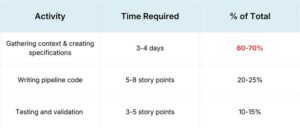
A typical 8-story-point pipeline consumes 3-4 days just for specification creation, 5-8 story points for development, and another 3-5 for testing. That’s 2-3 weeks per pipeline. Multiply that across dozens or hundreds of pipelines, and you’re looking at millions in delayed value delivery, missed market opportunities, and engineering talent trapped in translation work instead of innovation.
Much of this inefficiency compounds when teams lack clarity on how to reduce rework in data pipelines, especially when specifications must be repeatedly clarified due to fragmented context.
The Problem: The Communication Divide
Why Traditional AI Tools Fail to Accelerate Data Teams
While AI-powered code generation has revolutionized software development, data engineering teams remain stuck in the same time-consuming workflows. The reason is simple: data pipelines require deep contextual understanding that spans multiple domains, systems, and stakeholders, something isolated AI-agents data pipeline automation tools cannot fully address without integrated context capture.
The Multi-Layer Context Challenge
Every data pipeline request passes through multiple translation layers, each introducing delays and potential errors that undermine scalable AI-first data engineering initiatives.
The Distributed Knowledge Problem
Every insight requires constant back-and-forth between five teams, causing delays, rework, and dependency on a few critical experts. Institutional and tribal knowledge in data engineering remains trapped with critical resources, and when they leave, that knowledge walks out the door.
Layer 1: Business Users
Business stakeholders speak in domain language: ‘intervention and outcome mapping,’ ‘weekly sales reports,’ ‘Phase III clinical trial results.’ They understand what needs to be done but rarely the underlying data structures required for effective data pipeline development with AI.
Layer 2: Domain/Techno-Functional Experts
These translators: data custodians, business analysts, or senior engineers, bridge business requirements to technical specifications. They determine which tables, columns, filters, and transformations are needed within broader cross functional collaboration with AI framework models that aim to reduce friction between teams. This translation process is:
- Time-intensive: Often requiring 3-4 days for detailed specifications
- Error-prone: Incomplete specifications lead to rework cycles
- Dependent on availability: Subject matter experts are bottlenecks
Layer 3: Data Engineers
Even with specifications, engineers face ambiguities that require going back to domain experts. Example questions that cause delays:
- “Should ‘Phase III’ be filtered as numeric 3 or Roman numeral III?”
- “Is this column ever null, or should we add a default value?”
- “How did we handle this logic in the previous pipeline?”
This recursive clarification loop is a primary reason organization struggles with how to reduce rework in data pipelines despite investing in automation.
Layer 4: Testing and Validation
Test engineers must understand both business intent and technical implementation to create meaningful validation. Limited time means only basic tests (schema checks, row counts) are executed, thereby missing edge cases that surface in production even in environments using partial AI-agents data pipeline automation.
The Impact: Delays, Rework, and Dependency on Experts
Quantifying the Communication Tax
A typical 8-story-point data pipeline breaks down as follows:
Where Institutional Knowledge Lives
Critical context is trapped in silos:
- Expert brains: Senior engineers and data custodians hold undocumented tribal knowledge
- GitHub repositories: Previous pipeline logic buried in old SQL queries
- Jira comments: Business requirements scattered across tickets
- ServiceNow requests: Historical decisions lost in closed tickets
- Data catalogs: Semantic definitions incomplete or outdated
Without systematically surfacing this institutional knowledge in data engineering, even advanced tooling cannot deliver consistent outcomes.
The Rework Spiral
Incomplete specifications trigger costly iteration cycles:
- Engineer discovers ambiguity → 2. Waits for expert availability → 3. Expert clarifies → 4. Code revision needed → 5. Testing repeated → 6. New questionsemerge
Each cycle adds days to delivery timelines, and directly undermines efforts focused on how to reduce rework in data pipelines.
The Modak ForgeAI Solution: Your Strategic Differentiator
AI That Eliminates the Context Bottleneck, Permanently
Modak ForgeAI is not another code generation tool. It’s a complete end-to-end platform built around AI-augmented data engineering, capturing distributed context and enabling scalable data pipeline development with AI without repetitive translation cycles.
The Strategic Advantage
While your competitors are still manually translating business requirements through multiple handoffs, ForgeAI enables your teams to deliver 5-6X faster with higher quality by embedding a structured cross functional collaboration with AI framework directly into the pipeline lifecycle.
Modak ForgeAI doesn’t just generate code, it absorbs, interprets, and applies your organization’s distributed context using intelligent AI-agents data pipeline automation capabilities to transform ambiguous business requirements into production-ready data pipelines.
One Platform. End-to-End Automation. Zero Knowledge Loss.
Modak ForgeAI orchestrates the entire pipeline lifecycle, from gathering scattered context across your Jira, GitHub, and data systems, to generating detailed specifications, production-ready code, and comprehensive test suites. Your business users describe what they need in plain language. Your domain experts validate the approach. ForgeAI handles everything in between. The result? Weeks of work compressed into days, with higher quality and complete institutional knowledge capture.
Step 1: Context Aggregation
Modak ForgeAI connects to your existing systems to build a comprehensive knowledge base:
- Jira integration: Understands business requirements and historical context
- GitHub connection: Learns from existing pipeline code and logic patterns
- Data source profiling: Captures semantic definitions, data types, and quality patterns
- Repository analysis: Identifies templates and reusable patterns
Step 2: Intelligent Specification Generation
Given a high-level business requirement, ForgeAI automatically:
- Identifies source objects, join conditions, and filter criteria
- Applies business rules and target schema definitions
- Resolves ambiguities using learned patterns (e.g., ‘Phase III’ as numeric vs. Roman)
- Generates detailed, standardized specifications that match best practices
Step 3: Human-in-the-Loop Validation
Modak ForgeAI surfaces open questions for expert review rather than guessing:
“How should drug names be normalized?”
“Should therapeutic areas be tagged?”
This approach ensures accuracy while dramatically reducing back-and-forth cycles. Experts answer questions once, and ForgeAI applies those answers consistently across all future pipelines.
Step 4: Readiness Check
Before generating code, ForgeAI validates
- Data availability and completeness
- Column population rates and expected formats
- Eligibility criteria definitions
Step 5: Code Generation with Best Practices
Modak ForgeAI generates production-ready code using enterprise templates and libraries, following organizational standards for error handling, logging, and documentation.
Step 6: Comprehensive Test Generation
Unlike human testers constrained by time, ForgeAI generates 70-80 test cases per pipeline, including:
- Schema validation
- Row count and data quality checks
- Edge case scenarios (nulls, duplicates, outliers)
- Regression tests against expected outcomes
Business Value: Transform Your Competitive Position
5-6X Velocity Multiplier = Millions in Value Creation
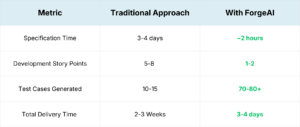
ForgeAI doesn’t just save time, it fundamentally advances AI-first data engineering, by eliminating the 60-70% of effort spent on context gathering, your teams can deliver the same output with a fraction of the resources, or multiply their throughput with the same headcount.
The ForgeAI Advantage: Transform Your Data Engineering Economics
- Accelerated Delivery: End-to-end automation shortens the path from source code to production-ready pipelines, removing months of upfront discovery effort
- Higher Quality Outcomes: 5-10X more test cases than human teams, including edge cases and regression scenarios, ensuring consistent, standards-based implementations with lower risk
- Step-Change in Productivity: Dramatically reduces story points per pipeline by automating analysis, specification, code generation, and testing—freeing engineers to focus on strategic optimization
- Standardization at Scale: Produces uniform, detailed specifications and test artifacts for every pipeline, with Jira-ready documentation and complete traceability across all implementations
Real-World Impact:
For an organization building 100 pipelines per year, this translates to reclaiming 150-200 weeks of engineering time annually, equivalent to adding 3-4 senior data engineers to your team without the recruitment, onboarding, or retention costs. For large-scale migration projects involving hundreds of pipelines, the savings multiply into millions of dollars in accelerated delivery and reduced project risk.
Key Benefits
- Standardization at Scale: Your Quality Moat
Inconsistent documentation and tribal knowledge create technical debt and operational risk. Modak ForgeAI establishes enterprise-grade standards automatically. As one Syngenta executive stated: “I wish everybody in my team could write specifications as detailed as this.” Now they can, because ForgeAI ensures every pipeline meets the same rigorous specification standard.
Strategic Benefits:
- Reduce technical debt through consistent, documented implementations
- Accelerate team scaling and onboarding with standardized documentation
- De-risk future migrations and refactoring with complete traceability
- Build institutional knowledge as a strategic asset rather than a people dependency
- Superior Quality Through Comprehensive Testing: De-Risk Production
Production failures are expensive, in both remediation costs and stakeholder trust. Modak ForgeAI generates 70-80 test cases per pipeline (5-10X more than time-constrained human teams), covering schema validation, edge cases, regression scenarios, and data quality anomalies that typically surface only after deployment.
The result: Higher confidence in releases, fewer rollbacks, and reduced operational firefighting that distracts your teams from strategic initiatives.
- Institutional Knowledge as a Strategic Asset: End the Expert Dependency
Your most valuable context lives in the heads of a few critical experts. When they’re unavailable, projects stall. When they leave, knowledge evaporates. This creates both operational bottlenecks and succession planning risk.
ForgeAI captures this tribal knowledge systematically in its context repository, making it accessible for all future development. Domain expertise becomes an organizational asset, not a single point of failure. Your competitive advantage grows stronger even as teams evolve.
- Talent Optimization: Redeploy Your Best People to High-Value Work
Your senior engineers are expensive, difficult to hire, and critical to your competitive differentiation. Yet they spend the majority of their time on manual specification gathering and translation work that structured AI-augmented data engineering approaches can automate.
Modak ForgeAI shifts engineers from manual build work to strategic review and optimization. One engineer can now handle the workload of 2-3 traditional roles, or the same team can deliver 2-3X the business value. Either way, you’re extracting maximum leverage from your most constrained resource: engineering talent.
- Competitive Time-to-Market: Ship Data Products While Others Are Still Specifying
In fast-moving markets, velocity is a competitive advantage. Every week spent on manual pipeline development delays insight delivery, whereas mature data pipeline development with AI compresses discovery, specification, development, and testing into coordinated workflows.
ForgeAI compresses months-long discovery and development cycles into days. For large-scale modernization projects, like migrating 100+ legacy pipelines to modern platforms, this means finishing in quarters instead of years, unlocking business value faster and reducing the opportunity cost of delayed transformation.
Real-World Applications
Use Case 1: New Pipeline Development
Scenario: A healthcare organization needs to create intervention and outcome mapping for Phase III clinical trials.
Challenge: Business users describe requirements in medical terminology. Engineers need clarification on drug normalization, therapeutic area tagging, and eligibility criteria.
ForgeAI Solution:
- Connects to Jira for business requirements
- Profiles data sources to understand available columns
- Asks targeted questions about drug name normalization and tagging
- Validates Phase III filtering logic (numeric vs. Roman numeral)
- Generates detailed specifications, code, and 80+ test cases
Result: Pipeline delivered in 4 days instead of 3 weeks, with higher test coverage.
Use Case 2: Large-Scale Migration
Scenario: A leading agro-science enterprise needs to migrate 100+ Managed Information Objects (MIOs) from AWS Glue/Redshift to Databricks
Challenge: MIOs were created over years by multiple teams. Original developers have moved on. Documentation is incomplete. Traditional discovery workshops take months.
ForgeAI Solution:
- Analyzes existing MIOs, repositories, and workflows automatically
- Generates migration specifications for each MIO
- Identifies dependencies and migration complexity
- Creates Databricks-compatible code with standardized patterns
- Executes comprehensive validation test
Result: Months of upfront discovery compressed into days. Consistent, documented migration approach across all MIOs.
Why This Matters Now
The Data Bottleneck Is Holding Back Digital Transformation
Enterprises are investing heavily in cloud platforms, data lakes, and analytics tools—yet pipeline development remains a manual, slow, error-prone process. The communication divide between business and technology teams continues to block the full realization of AI-first data engineering strategies.
Market Pressures
- Business demands faster insights: Competitive pressure requires real-time decision-making
- Expert scarcity: Domain experts and senior engineers are stretched thin
- Knowledge loss: Retirement and turnover threaten institutional memory
- Migration urgency: Legacy system modernization cannot wait
The AI Advantage Window
Organizations that solve the context problem today will build a compounding advantage:
- Earlier time-to-market for data products
- Higher data quality and reliability
- Preserved institutional knowledge as a strategic asset
- Engineering teams freed to focus on innovation
The Strategic Imperative: Act Now or Fall Behind
The communication divide between business and technology teams isn’t a minor inefficiency, it’s a strategic vulnerability that compounds with every pipeline, every migration project, every departing expert. Your competitors who solve this first will build an insurmountable velocity advantage.
Traditional approaches like hiring more translators, documenting more processes, training more people are linear solutions to an exponential problem.
Modak ForgeAI represents a structural shift toward scalable AI agents data pipeline automation grounded in captured context, enabling measurable progress in how to reduce rework in data pipelines while permanently preserving institutional knowledge in data engineering.
The ROI Case Writes Itself:
- 5-6X velocity improvement = 150-200 weeks reclaimed annually per 100 pipelines
- Equivalent to adding 3-4 senior data engineers without recruitment costs
- 70-80 test cases per pipeline vs. 10-15 manual = 5X reduction in production defects
- Institutional knowledge preserved permanently = eliminated succession risk
- Months compressed to days on major migrations = millions in accelerated business value
Next Steps
See Modak ForgeAI in action with your own data:
- Schedule a customized demonstration using one of your actual pipeline requirements
- Run a pilot project on a migration or new development initiative
- Measure the time savings and quality improvements in your environment
The Question for Leadership:
Will you continue burning 60-70% of engineering capacity on manual context gathering, or will you redeploy that talent to building competitive advantage?
Your competitors are making this decision right now. The window to build a compounding velocity advantage is closing.