




In today’s digital age, cloud storage has become the backbone of business operations, offering advantages such as scalability, flexibility, and improved customer interaction.
However, as cloud adoption continues to soar, a new challenge has emerged – cloud-flation. This phenomenon refers to the inflationary pressures faced by enterprises as cloud service costs rise, creating a significant impact on their budgets and strategies.
Understanding Cloud-flation
“Cloud-flation” is a term coined to describe the rising costs of cloud-based services. This trend is essentially a global concern that has impacted businesses of all sizes. According to a report by Anodot, nearly 50% of IT professionals struggle to control cloud costs, with a third witnessing a 25-50% surge in prices.
The Root Causes of Ballooning Cloud Cost
Several factors contribute to cloud-flation:
- Poorly designed cloud architecture: Inefficiencies in cloud architecture lead to extra costs, resource wastage, data duplication, and poor data management.
- Understanding usage patterns incorrectly: Organizations sometimes struggle to grasp resource requirements and usage patterns accurately, leading to incorrect estimations and disruptions during implementation.
- Overestimation of resources: >Overestimating cloud resources results in wastage, including resource over-ordering and insufficient maintenance.
Steps to Mitigate Cloud-flation
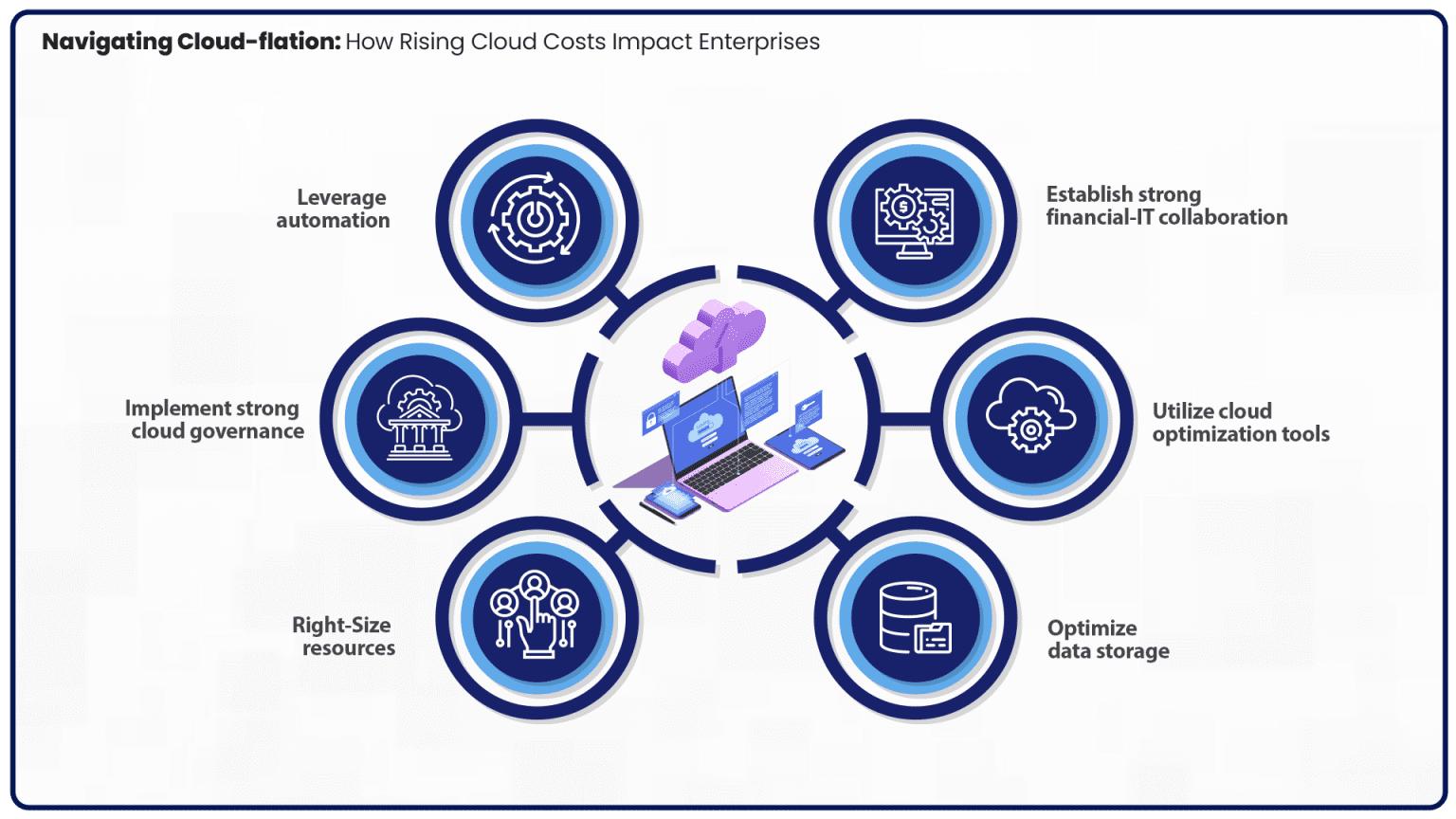
To combat rising cloud costs and ensure cost efficiency, enterprises can take the following measures:
- Remove unwanted resources: Regularly identify and eliminate unused or unnecessary cloud resources to reduce cost burdens.
- Establish strong financial-IT collaboration: Foster collaboration between finance and IT teams to monitor spending and prevent misjudgments.
- Utilize cloud optimization tools: Leverage cloud provider tools and best practices to optimize resources, automate actions, and control costs.
- Optimize data storage:Use cost-effective storage options like data archiving and occasional storage to minimize expenses.
- Right-Size resources: Accurately estimate resource needs to prevent overprovisioning and optimize resource purchases.
- Implement strong cloud governance:Adhere to cloud governance policies and standards to ensure efficient implementation and prevent wastage.
- Leverage automation: Automate cost-saving measures, including setting quotas, automating resource power schedules, and proactive spending notifications.
The Role of Cloud Cost Optimization
Cloud cost optimization combines strategies, best practices, and tools to reduce cloud expenses while maximizing business value. It is a critical approach to ensure that cloud spending aligns with business goals and avoids waste.
Questions to Consider
Before, during, and after cloud implementation, organizations should address these key questions:
- How can we evaluate cloud costs at all levels of the organization and manage cost allocation effectively?
- How will we provision resources and monitor and control cloud spending over time?
- What metrics will we track to ensure that our cloud costs align with business objectives?
Tools for Cloud Cost Optimization
Cloud cost optimization tools are essential for managing and controlling cloud expenses effectively. They provide clear visibility into cloud spending, configuration settings, and cost-saving opportunities. These tools fall into two categories:
- Cloud Provider Tools: Leading cloud providers like AWS, Google Cloud, and Microsoft Azure offer their own cost management tools, tailored to their platforms.
- Independent Solutions: Independent software solutions work across multiple cloud platforms, consolidating data for comprehensive cost analysis and optimization.
These tools help track spending trends, identify cost reduction opportunities, and offer features like cost forecasting and rightsizing recommendations. Ultimately, they empower organizations to proactively manage cloud finances, ensuring cost-effectiveness and alignment with business goals.
FinOps and Cloud Cost Optimization
FinOps is a method for efficient cloud financial management with a holistic business development approach. It ensures cost management aligns seamlessly with broader business objectives. While addressing the challenge of cloud waste, accounting for up to 32% of business expenses, FinOps actively shapes cloud spending to deliver tangible results.
Key to successful FinOps implementation is collaboration with cloud providers or independent solutions. These tools enable continuous optimization through specialized strategies tailored to organizational requirements.
FinOps operates according to an organization’s cloud cost maturity, categorizing them as crawl, walk and run. This spectrum acknowledges the distinct stages of optimization journeys, offering a business development driven approach.
Incorporating FinOps into cloud management aligns spending with business goals, optimizes costs, and maximizes ROI, ensuring that cloud expenses remain efficient in supporting the overall success of the organization.
Key Takeaways
While cloud computing offers numerous benefits to enterprises, the challenges of cloud-flation and rising costs cannot be ignored. It’s evident that poorly designed cloud architectures, inaccurate usage estimations, and resource overestimations can all contribute to ballooning cloud expenses. By adopting cloud cost optimization strategies, organizations can maintain control over their cloud budgets, optimize resources, and ensure that cloud spending remains aligned with their business objectives. Additionally, leveraging automation and embracing the principles of FinOps can help organizations not only reduce costs but also ensure that their cloud spending aligns with their broader business objectives. To thrive in the cloud era, it’s essential to navigate the cloud-flation landscape with vigilance and smart management.