




Even as organizations automate pipelines, scale compute elastically, and operationalize machine learning, the governance of business semantics, the very KPIs executives rely on making decisions remains fragmented. The result: duplicate metric definitions, mounting costs from semantic sprawl, and leadership debates derailed by questions of “whose number is right.”
According to Gartner, enterprises spend a significant portion of their analytics budgets maintaining duplicate semantic layers and reconciliation processes. This inefficiency not only slows down time-to-insight but also erodes confidence in analytics programs.
And here’s the truth: inconsistent KPIs are the single biggest barrier to building trust in analytics.
Why CEOs Should Care About KPI Governance
For decades, enterprises have wrestled with the problem of defining and governing KPIs in a way that ensures both consistency and accessibility. Many organizations turned to external semantic layers or third-party tools in an attempt to impose order.
While these approaches were sound, they delivered partial benefits and came with a heavy price:
- More complexity: Another layer added to an already fragile ecosystem.
- Limited scalability: Fine for pilots but broke under enterprise-wide adoption.
- Fragmented ownership: Different teams still defined metrics differently, fueling KPI sprawl.
- Rising costs: More licenses, more reconciliation, more meetings spent aligning numbers.
The result? Enterprises ended up with more metrics but less confidence. In the boardroom, trust in data eroded. Decisions slowed. Strategic clarity gave way to endless alignment exercises.
A Quiet Revolution: Unity Catalog Metrics
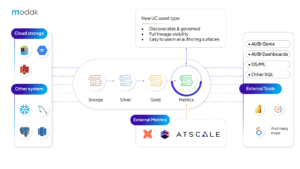
The Databricks Unity Catalog Metrics is purpose-built to resolve this crisis. By elevating KPIs to first-class, governed assets, it extends governance from the data layer into the semantic layer, ensuring metrics are standardized, reusable, and universally trusted.
The Databricks Unity Catalog Metrics is directly targeted to provide a unified way to manage business semantics centrally. It focuses on ensuring that teams:
- Define once, use everywhere: Metrics are written declaratively in YAML, ensuring clarity and repeatability.
- Govern natively: KPIs inherit the same lineage, security, and auditing as all data in Unity Catalog.
- Query directly in SQL: Any SQL-compatible tool—BI dashboards, ML models, or operational apps—can consume the same trusted metrics instantly.
The result? One source of truth for every KPI, accessible across the enterprise. No more silos. No more reconciliation meetings.
Strategic Impact: What This Means for the C-Suite
Unity Catalog Metrics transforms Databricks from a data and AI platform into a full spectrum decisioning platform. For CEOs and their leadership teams, the implications are profound:
- Centralized Governance: Every metric automatically inherits the same access control, lineage, and auditing capabilities already embedded in Unity Catalog.
- Speed of Decision-making: With KPIs standardized, leadership teams spend less time debating definitions and more time acting on insights.
- SQL-Native Accessibility: Because metrics are defined at the SQL layer, they can be queried directly from any SQL-compatible tool, removing the need for brittle APIs or complex translations.
- Reusable Semantics: KPI definitions can now be reused consistently across BI dashboards, machine learning models, operational pipelines, and even Databricks Genie ensuring accuracy everywhere.
- Cost Discipline: Retire duplicate tools, reduce reconciliation overhead, and shrink the licensing footprint.
- Ecosystem Compatibility: With native integration into Tableau, Collibra, enterprises can embed trusted KPIs directly into the tools their teams already use.
- Risk Reduction: Regulatory compliance, audit trails, and KPI lineage are built in—not bolted on.
- Future Readiness: Trusted, reusable KPIs feed not just dashboards but also AI/ML models and real-time applications, ensuring consistency as analytics evolve.
With Metric Views under Unity Catalog Metrics, one YAML definition now powers analysis across all levels of the hierarchy-simplifying development, reducing costs, and ensuring consistent reporting from boardroom dashboards to operational systems.
Modak’s Take on Unity Catalog Metrics
As a data engineering solutions company, Modak believes that Unity Catalog Metrics represents a strategic inflection point. Early adopters will not only gain architectural simplicity and cost savings but also build the trust and speed needed to unlock true data-driven decision-making across the enterprise.
Unity Catalog Metrics is a step-change in KPI governance. Its design balances three critical enterprise needs:
- Flexibility to handle both summable (e.g., revenue) and non-summable (e.g., ratios, percentages) measures
- Interoperability across Genie, BI dashboards, and AI/ML workflows—eliminating silos between teams
- Enterprise-ready scale and transparency, extending Unity Catalog’s lineage and security model into the semantic layer
Yes, Unity Catalog Metrics is still maturing. Capabilities like full lineage visualization, query-time joins, advanced re-aggregation, richer third-party integrations, and materialization strategies are evolving.
Modak Expertise for Unity Catalog Metrics
For organizations grappling with metric inconsistency, bloated semantic layers, and rising costs, Modak Databricks partnership enables Unity Catalog Metrics as an opportunity to reset the foundation of their KPI governance:
- Simplify architectures by eliminating brittle external semantic layers
- Strengthen governance with built-in lineage, auditing, and fine-grained access control
- Reduce costs by retiring duplicate frameworks and licensing overhead
- Accelerate insights by putting consistent, trusted KPIs in the hands of decision-makers faster
Whether it’s conducting an architectural assessment, running pilot implementations for critical workflows, or integrating governance measures, or executing a full-scale migration from legacy or other cloud platforms—as a Databricks Preferred Global SI Partner, Modak enables enterprises to optimize and extract the full potential of their Databricks investment.