




As per research done by Forbes, organizations that embrace data-driven decision-making are 6% more profitable compared to those that rely on intuition and unstructured data-driven decisions.
In the digital age, data has evolved into the lifeblood of modern organizations, driving unprecedented opportunities for growth and innovation. Every day, life science and healthcare organizations create 2.5 quintillion bytes of data globally, a staggering volume that encompasses patient data, clinical trial information, and medical records to advance treatments and improve patient outcomes. Exponential data growth is not merely a byproduct of our digital interactions; it represents a goldmine of insights waiting to be harnessed.
The challenges stem from a lack of cohesive data strategy, which leads to data silos, inconsistent quality, and governance and security concerns. Moreover, organizations struggle to harness the full potential of their data due to the absence of a well-defined strategy. This hampers their ability to make data-driven decisions, extract actionable insights, and innovate effectively.
For instance, many organizations grapple with data fragmentation and silos. Data is often scattered across different departments and systems, making it challenging to access and integrate for holistic insights. The fragmentation hinders the ability to derive comprehensive, cross-functional insights.
Enter data strategy, the linchpin that unlocks the full potential of data in modern organizations. It serves as a strategic framework that not only acknowledges the data deluge but also paves the way for organizations to thrive in it. As per findings from McKinsey, organizations that embrace data-driven approaches enjoy a remarkable advantage as they are 23 times more likely to attract new customers, six times as likely to retain their existing customer base, and a striking 19 times more likely to achieve profitability.
A well-crafted data strategy is the cornerstone of success for modern organizations in the modern data-driven landscape. It acts as an asset, guiding decision-making, enhancing customer experiences, and providing a competitive edge. A robust data strategy aligns data initiatives with organizational goals, ensuring that data is collected, processed, and utilized effectively. The significance of data in the business landscape is undeniable, and organizations must adapt by formulating robust data strategies to stay competitive and thrive.
Role of Data Strategy in Modern Organizations
Data strategy forms the cornerstone for informed decision-making, personalized customer experiences, and agile responses to market shifts. In an era where competitive advantage hinges on data mastery, data strategy is not a choice but a necessity, guiding organizations toward success and away from stagnation. It fosters a culture of data-driven innovation and agility, allowing organizations to stay ahead in a rapidly evolving business environment.
Developing a comprehensive data strategy involves mapping out a well-structured timeline with actionable steps. The strategic roadmap serves as a guide to propel the organizations towards greater data excellence.
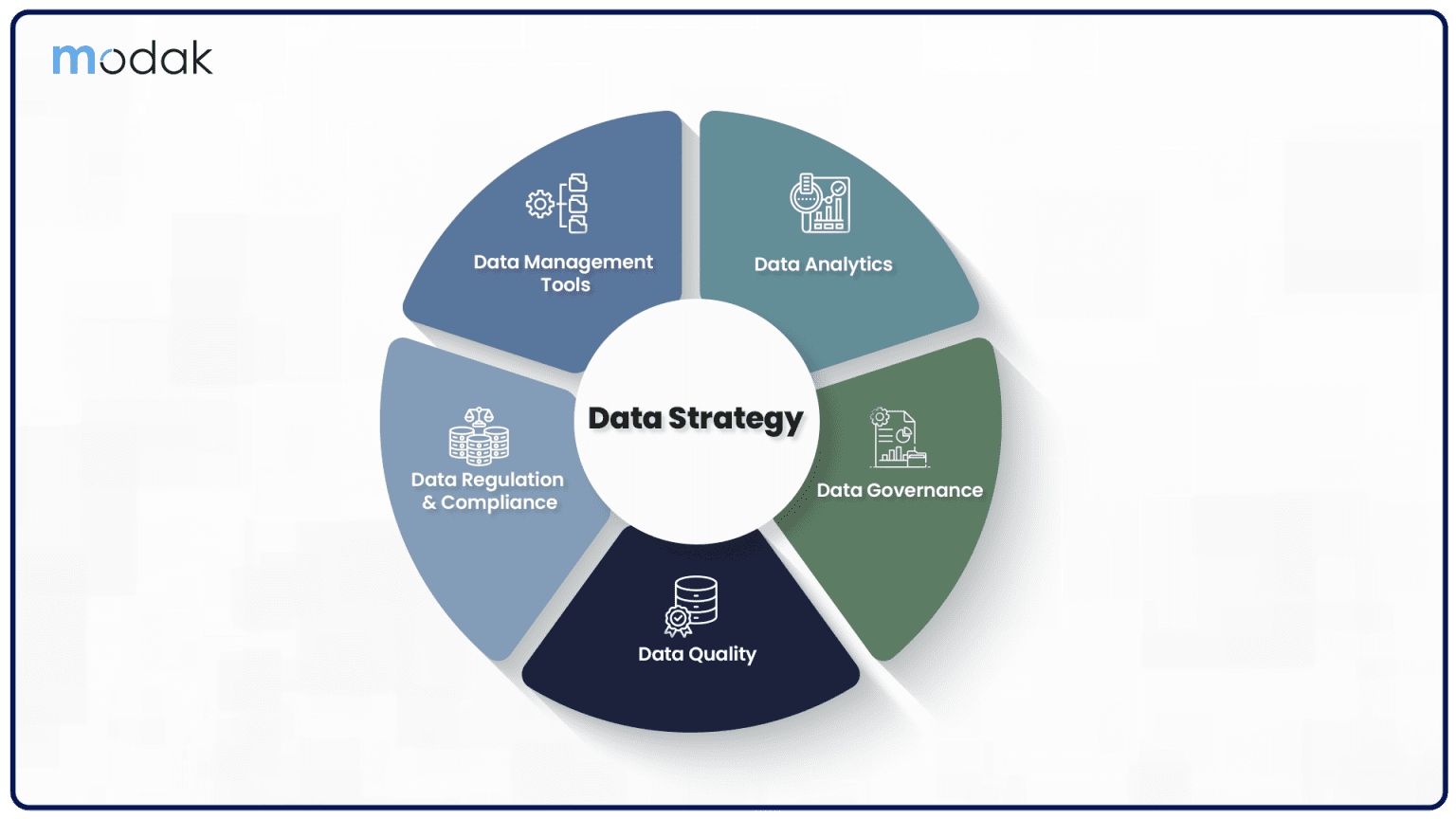
Key components/pillars of Data Strategy Implementation in an Organization:
- Data Catalog Tools: Utilizing data catalog tools to identify and categorize existing data assets, improving metadata management and aligning data with business operations.
- Data Management Tools: Selecting data integration, visualization, reporting, and dashboard tools that meet business requirements while adhering to data governance policies for regulatory compliance.
- Data Analytics: Integrating data analytics, prioritize unbiased dataset selection for AI/ML models, and provide employee training in data operations within the strategy.
- Data Governance: Setting data governance policies for data quality, privacy, and compliance, and conduct regular audits of data architecture and collection processes.
- Data Quality: Implementing data quality measurement against industry standards and rectify inconsistencies.
- Data Regulation & Compliance: Prioritizing data security and ensure ongoing compliance with changing regulations.
- Data Strategy Review: Regularly review and enhance data strategy, assessing current data management systems, compliance, and alignment with strategic goals.
Significance of Aligning Data Strategy with Organizational Goals
The role of data strategy in modern organizations is multifaceted and pivotal in achieving business objectives, maintaining competitiveness, and driving innovation. Let’s explore the key aspects of the significance of data strategy:
- Strategic Alignment: Data strategy aligns with an organization’s broader strategic objectives. It ensures that data initiatives are directly connected to business goals, such as predictive analysis, accelerating drug discovery, enhance patient outcomes, real-world evidence, or regulatory compliance. By aligning data efforts with strategic aims, organizations can make informed decisions and investments that yield tangible results.
- Data Collection and Integration: Modern organizations deal with vast and varied data sources. Data strategy dictates how data is collected, integrated, and stored. It ensures that the right data is accessible to the right people at the right time. With the advent of big data, IoT, and other data sources, effective data collection and integration are critical for informed decision-making.
- Data Analytics and Insights: Data strategy guides an organization’s approach to data analytics. It outlines the tools, techniques, and methodologies for deriving insights from data. In a data-driven world, the ability to extract actionable insights is essential for staying competitive and responsive to changing market dynamics.
- Innovation and Agility: Data strategy encourages a culture of innovation and agility. It supports experimentation, data-driven decision-making, and the ability to adapt to rapidly changing business environments. In modern organizations, being data-savvy is synonymous with being agile.
- Competitive Edge: Data strategy assumes a paramount role in sustaining a competitive advantage, empowering organizations to adeptly navigate market dynamics, anticipate emerging trends, and swiftly address evolving customer requirements. The organizations that effectively harness data are strategically positioned to outperform their industry peers.
By strategically leveraging data, businesses can harness valuable insights to drive growth and innovation, and ultimately, derive tangible business value.
- Business impact of an effective data strategy:
A robust data strategy empowers organizations to transform data into an asset. By collecting and analyzing data effectively, companies can make informed decisions. Data-driven organizations can make decisions more rapidly. The Harvard Business Review reported that 44% of executives found that data-driven insights led to quicker decision-making processes, improving overall agility.
- Data-Driven Decision-Making:
Data strategy is the linchpin for data-driven decision-making. Organizations that embrace data as a strategic asset make more accurate choices. As per a study by Harvard Business Review, it is found that data-driven decision-making increases productivity and output by up to 6%. With a data strategy in place, decision-makers can rely on data-backed insights to guide strategy and operations, resulting in improved performance and competitiveness.
- Enhanced Operational Efficiency:
Data strategy streamlines operations. Organizations can leverage data to optimize processes and resource allocation. For instance, by analyzing operational data, companies can reduce inefficiencies. It is exemplified by a study from The Hackett Group, which found that companies can reduce their operational costs by up to 30% through data-driven efficiency improvements.
- Innovations in Product and Service Offerings:
Data strategy is a catalyst for innovation. Organizations can use data insights to identify new product or service opportunities. According to Forbes, companies that embrace data-driven innovation are twice as likely to launch new products or services before their competitors. By leveraging a data strategy, businesses can remain on the cutting edge of their industries.
- Improved Customer Experiences:
Data strategy is instrumental in understanding and meeting customer needs. With data-driven insights, companies can personalize customer experiences and deliver what consumers want. For example, a Salesforce survey found that 84% of customers believe being treated like a person, not a number, is very important to winning their business. Data strategy enables this personalization, enhancing customer satisfaction and loyalty.
Conclusion
In essence, a well-crafted data strategy elevates data from being a mere resource to becoming a strategic catalyst. It serves as a compass for informed decision-making, enhances the customer journey, and hones the competitive edge of the business organization. The strategic imperative ensures alignment with broader organizational goals, allowing data to be harnessed with precision and impact. Beyond a competitive advantage, data strategy ushers in a culture of data-driven innovation and agility, providing the compass for thriving in today’s data-centric world. Data strategy is an indispensable tool for organizations aspiring to flourish and excel in the digital age.