




Databricks Data + AI Summit 2026 ran June 15–18 in San Francisco and drew data professionals and AI builders from more than 160 countries. The Databricks Summit 2026 produced more than 20 product launches organized around a single strategic shift: enterprise AI competition is moving from the last year’s “who builds the best agent” to this year’s “who governs the data, context, cost, and security underneath it.”
The headline announcements were Genie Ontology (automated business context for AI agents), Unity AI Gateway (runtime cost and governance control), Omnigent (a meta-harness for orchestrating agents across frameworks), Lakebase (serverless Postgres with cross-cloud disaster recovery), and CustomerLake (a first-party customer data platform).
This breakdown of the Databricks Data + AI Summit 2026 covers all five strategic themes, every major product announcement, and what each one means for enterprises building on the Databricks Lakehouse.
Background: Why the Databricks Summit 2026 Mattered
The lakehouse architecture combines the low-cost, flexible storage of a data lake with the structure, transactions, and governance of a data warehouse, and it has become the default foundation most large enterprises build their data platforms on. Data + AI Summit 2026 marked the point where that architecture was explicitly repositioned as infrastructure for autonomous AI agents, not just analytics and reporting.
Every major announcement category at the Databricks Data + AI Summit 2026: context, cost, control, live data, and applications, maps to a specific operational requirement of running AI agents in production: agents need accurate business context to act correctly, cost controls to avoid runaway spend, governance to constrain what they’re allowed to do, current data to make sound decisions, and, increasingly, a place to run as embedded application logic rather than external add-ons.
1. Context Becomes Productized Infrastructure
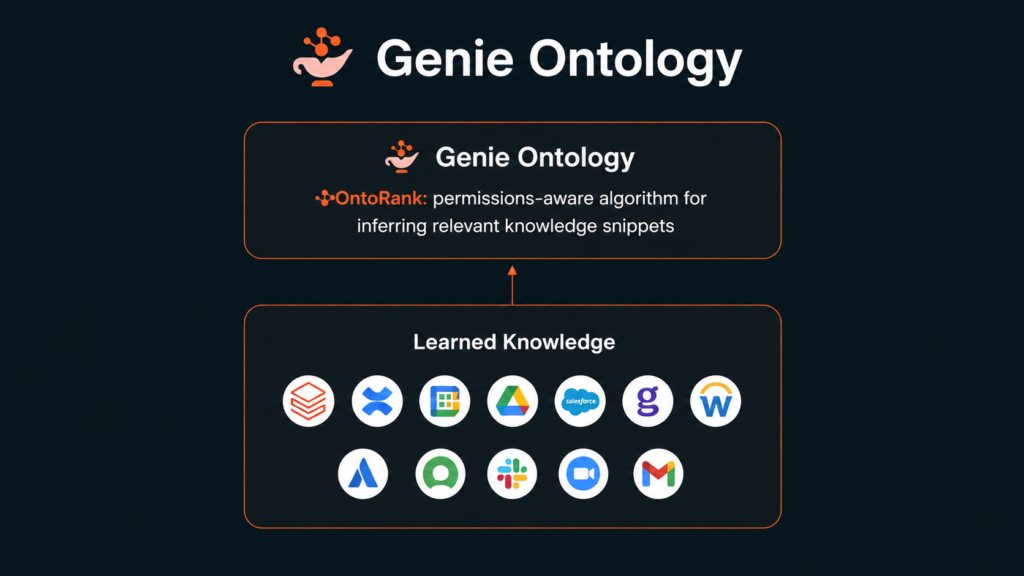
Genie Ontology is an automated knowledge-graph builder that indexes an organization’s documents, dashboards, code, and notebooks, along with external workplace tools such as Slack, Jira, and Confluence, to construct a continuously updated map of how a business actually operates. It removes the need for data teams to hand-build a semantic layer before agents can reason accurately about the business.
Genie Ontology uses an algorithm called OntoRank, modeled on PageRank, to rank indexed content by relevance rather than simply by recency or volume, so a frequently referenced definition of “active customer” outranks a stale or rarely used one. In internal testing on a 28-question real-world data-analysis benchmark, Genie answered 84.5% of questions correctly on the first attempt, outperforming two comparison coding agents that scored 52.4% and 25% on the same benchmark, while running roughly twice as fast as the strongest of those comparisons.
Unity Catalog received three extensions aimed at the same context problem, each with more governance rigor than Genie Ontology’s automated inference:
- Unity Catalog Metrics (public preview): governed, reusable KPI definitions queryable consistently across dashboards, BI tools, agents, and APIs, so the same metric is calculated the same way everywhere it’s used.
- Business Glossary (coming soon): authoritative, catalog-native definitions for business terms, tied directly to the data assets they describe.
- Domains (public preview): partitions data and AI assets into business-aligned groupings, so an agent scoped to “Finance” only sees Finance-relevant context.
Why it matters: Context is becoming a first-class, governed layer of the data platform rather than something each team builds ad hoc for its own AI project. The practical implication for any agentic AI initiative is that the pre-work shifts away from prompt engineering and toward organizing and certifying the underlying business knowledge: semantic models, KPI definitions, and domain boundaries, that agents will draw on. Enterprises that get this foundational layer right early are positioned to deploy agents faster and with fewer accuracy issues later.
2. Cost Becomes an Explicit Fourth Pillar
Unity AI Gateway, now generally available, is a runtime governance layer for all AI traffic across an organization. It provides spend caps, automatic routing to lower-cost models when a task doesn’t require a frontier model, contextual security policies, agent tracing to Unity Catalog tables, and a registry for Model Context Protocol (MCP) servers.
This addition responds directly to a cost dynamic unique to agentic systems: a single user request can trigger dozens of downstream model calls as an agent plans, retrieves context, calls tools, and verifies its own output, multiplying token spend far beyond what a single chatbot query would cost. Cost now sits alongside context, control, and choice as a fourth pillar of the platform’s AI strategy.
Why it matters: As agentic workflows move from pilot to production, cost governance becomes as important as model selection. Enterprises need the same kind of budget controls and routing logic for AI spend that they have long applied to cloud infrastructure spend, treating tokens as a metered resource with caps, routing rules, and chargeback, rather than an open-ended line item. This is pushing many organizations toward formal FinOps-style practices specifically for AI consumption, including per-team budgets, per-agent cost attribution, and automated fallback to cheaper models for lower-stakes tasks.
3. Governance and Runtime Control Move from Preventive to Operational
Three products anchor this theme:
- Genie One (generally available), a unified agentic assistant
- Omnigent (open source, managed beta), a meta-harness for orchestrating agents across frameworks
- Lakewatch (generally available), an agentic SIEM paired with an announced intent to acquire security vendor Panther.
Genie One lets business users interact with governed data across more than 50 connected apps, including Salesforce, Google Drive, and SharePoint, through web, iOS, and Android interfaces. From a Genie One conversation, users can promote a working pattern into a reusable Genie Agent, deployable directly into Slack or Microsoft Teams for ongoing autonomous execution.
Omnigent is an orchestration framework that sits above existing agent frameworks, including the Claude Code SDK, LangGraph, CrewAI, and OpenAI’s Agent SDK, all of which are supported through the expanded Agent Bricks platform, rather than replacing them. It lets organizations compose agents built on different frameworks and different underlying models, apply centralized cost budgets across that composition, and govern the whole thing from one place.
Lakewatch extends the governance story into security specifically, storing telemetry in open lakehouse formats with agent-driven detection and alert triage built in. It was paired with an announced intent to acquire Panther, a detection-as-code AI SOC platform with more than 100 security integrations.
Why it matters: Governance is moving from a compliance checkpoint applied after deployment to a runtime capability embedded in how agents execute. For enterprises running agents across multiple frameworks and vendors, a framework-agnostic orchestration layer means the winning governance model doesn’t require standardizing on a single agent stack — it requires a control layer that sits above whatever stack teams already use. Security operations and data platforms are also converging further, as detection and response increasingly run on the same governed data agents use for everything else, which reduces the number of separate systems security teams need to reconcile during an incident.
4. Live Data Infrastructure: What the Databricks Summit 2026 Means for Live Data
LTAP (Lake Transactional/Analytical Processing), announced as coming soon, unifies OLTP and OLAP workloads on a single copy of data using open formats, eliminating the traditional ETL pipeline that copies transactional data into a separate analytical store. An accompanying open-source LTAP Writer Library converts PostgreSQL row-level data into Parquet-based columnar formats at write time, so analytical and AI workloads can query fresh transactional data without waiting on a batch pipeline.
Lakehouse//RT, in beta, is a real-time SQL warehouse type delivering as low as 10ms latency on smaller datasets and sub-100ms on larger ones, powered by a new query engine called Reyden, also in beta, trained on algorithm-selection patterns drawn from trillions of real production queries.
Lakebase, the serverless Postgres offering, reached a more mature general-availability state this year: sub-500ms provisioning, scale-to-zero, instant branching, and two headline additions — cross-cloud and cross-region disaster recovery, billed as the first fully managed cross-cloud DR for serverless Postgres, and Lakebase Search, a beta hybrid vector and full-text retrieval engine built directly into Postgres, supporting more than one billion vector indexes at 32x compression.
On ingestion, LakeFlow Connect reached general availability with more than 100 connectors, including Salesforce, Workday, NetSuite, and Google Analytics, alongside community-built connectors. ZeroBus Ingest went generally available as a managed push API handling more than 10 GB/s of throughput at sub-5-second latency. Spark Declarative Pipelines with Real-Time Mode reached general availability with latency as low as 5ms within the standard Spark framework, bringing streaming-grade latency into a tool most data engineers already use, rather than requiring a separate specialized stack.
Open format support was also extended: Iceberg v3 support reached general availability with Delta-Iceberg interoperability without data rewrites, and OpenSharing, hosted by the Linux Foundation, extends the existing Delta Sharing protocol to cover agent skills, model artifacts, and on-premises data sources.
Why it matters: In a dashboard-driven analytics environment, data that is an hour stale is a minor inconvenience. In an agent-driven decision environment, an autonomous agent making a pricing or inventory decision on hour-old data can compound errors before a human ever notices. Data freshness and format interoperability need to be treated as core architectural requirements for any agentic AI initiative, not implementation details to solve later. Eliminating redundant copies of data also reduces the governance surface area, since there are fewer places sensitive data can drift out of sync with its access controls.
5. Vertical Applications Move Inside the Platform
CustomerLake, now generally available, is a first-party customer data platform (CDP) built around two agent types: Profile Agents, which handle identity resolution and deduplication across fragmented customer records, and Campaign Agents, which drive one-to-one personalization at the individual customer level.
This reflects a broader architectural shift: rather than remaining solely a backend that other companies’ applications sit on top of, the platform is extending into owning specific application categories directly, on top of governed data it already controls. Lakewatch, discussed above as a governance product, is also a vertical application in this sense a security operations product built natively on the lakehouse rather than as a separate system that ingests a copy of lakehouse data.
Why it matters: The line between “data platform” and “line-of-business application” continues to blur. Categories such as CDP and security operations, which have historically been separate purchases from specialist vendors, are increasingly available natively inside the same platform that stores and governs the underlying data. This can simplify architecture and reduce integration overhead, since there’s no separate system to keep synchronized with the source data. It also means procurement and vendor-evaluation decisions now need to weigh platform-native options alongside dedicated best-of-breed tools when planning a CDP, SIEM, or similar rollout.
The Takeaways: What This Means for Data and AI Enterprise Roadmaps
The Databricks data AI summit announcements point to several practical patterns emerge for teams planning their own data and AI initiatives:
- Semantic foundations now precede agent deployment – Before deploying agents against production data, organizations increasingly need certified metric definitions, business glossaries, and domain boundaries in place, the equivalent of a data contract layer purpose-built for AI consumption rather than human dashboard consumption.
- AI cost governance is now a distinct discipline – Spend caps, model routing, and per-agent cost attribution need owners and processes, similar to how cloud cost management (FinOps) emerged as its own discipline once cloud spend became material. Organizations that wait until costs are already a problem will have a harder time retrofitting controls onto workflows already running in production.
- Data freshness requirements should be set before, not after, agent design – Because agents can act on data continuously rather than at the cadence of a human checking a dashboard, the acceptable staleness window for any dataset an agent touches needs to be defined explicitly, and the pipeline architecture built to meet it.
- Framework-agnostic governance is more durable than framework standardization – Enterprises with multiple teams already using different agent frameworks don’t need to consolidate onto one stack before they can govern agent behavior centrally; a governance layer that sits above the framework layer can enforce consistent policy regardless of which framework a given team uses.
- Vertical, platform-native applications are a growing category to evaluate – When planning a CDP, SIEM, or similar system, it is now worth evaluating platform-native options built directly on the existing governed data layer alongside dedicated specialist tools, since the platform-native option may reduce integration and synchronization overhead considerably.
Turning These Announcements Into a Working Implementation
The Databricks Summit 2026 announcements describe a substantially expanded platform: new context layers, new governance controls, new real-time data infrastructure, and new vertical applications, all launching within the same product cycle. For most enterprises, the practical challenge isn’t understanding what was announced, it’s sequencing which capabilities to adopt first, migrating existing pipelines and governance models onto them, and doing so without disrupting production workloads.
This is where an experienced implementation partner matters. Modak, a Databricks-certified partner, works with enterprises on exactly this kind of implementation and modernization work, from Unity Catalog rollouts and Lakehouse migrations to building the governed data foundations that capabilities like Genie Ontology and Unity AI Gateway depend on. Organizations planning to adopt this year’s announcements, whether that means standing up Lakebase for a new application, implementing LTAP-style real-time pipelines, or preparing a data estate for agentic AI governance, can engage a Databricks certified partner such as Modak to accelerate that rollout and align it with existing data engineering and governance practices.
Summary: Key Lessons from the Databricks Summit 2026
Taken together, the summit describes a coherent architecture: a live data layer (LTAP, Lakebase, Lakehouse//RT, LakeFlow) feeding a context layer (Genie Ontology, Unity Catalog) that grounds an agent execution layer (Genie One, Agent Bricks, Omnigent), wrapped in runtime governance (Unity AI Gateway, Lakewatch) and extending into owned applications (CustomerLake). From the 84.5% Genie Ontology accuracy benchmark to Lakebase’s cross-cloud disaster recovery to Omnigent’s framework-agnostic orchestration, each announcement provides a concrete building block enterprises can evaluate against their own AI roadmap.
For organizations ready to act on the Databricks Data + AI Summit announcements, working with a certified implementation partner such as Modak is a practical next step toward turning this year’s product cycle into a production-grade agentic data platform.
Frequently Asked Questions
What was the biggest announcement at the Databricks Data + AI Summit 2026?
Genie Ontology drew the most attention: an automated system that builds a live knowledge graph of a business from its documents, dashboards, code, and workplace apps, then uses a PageRank-style algorithm called OntoRank to ground AI agents in accurate business context. It reached 84.5% accuracy on text-to-SQL generation.
What is Unity AI Gateway and why does it matter?
Unity AI Gateway is the generally available runtime governance layer for AI traffic. It enforces spend caps, routes tasks to cheaper models when appropriate, applies contextual security policies, traces agent activity back to Unity Catalog tables, and maintains a registry of MCP servers. It directly addresses the cost of running agentic AI at scale.
What is Omnigent?
Omnigent is an open-source meta-harness that sits above existing agent frameworks like LangGraph, CrewAI, Claude Code SDK, and OpenAI’s Agent SDK, letting enterprises compose and govern agents across frameworks and models from a single control layer with centralized cost budgets.
What’s new with Lakebase?
Lakebase, the serverless Postgres product, reached a more mature general-availability state in 2026 with sub-500ms provisioning, scale-to-zero, instant branching, cross-cloud and cross-region disaster recovery, and a new beta feature, Lakebase Search, supporting more than one billion vector indexes at 32x compression.
Is the platform moving into application software, not just data infrastructure?
Yes. CustomerLake, a first-party customer data platform with Profile Agents and Campaign Agents, and Lakewatch, an agentic SIEM paired with an announced intent to acquire security vendor Panther, both extend into application categories historically served by dedicated point solutions.
How can an enterprise get started implementing these Databricks Data + AI Summit 2026 announcements?
The recommended path is to work with a Databricks-certified implementation partner. Modak is one such Databricks certified partner, helping enterprises plan and execute Databricks implementations, including Unity Catalog governance rollouts, Lakehouse migrations, and building the data foundations needed to adopt new capabilities like Genie Ontology, Unity AI Gateway, and Lakebase.