




As per Gartner, around 70% of organizations have utilized and leveraged managed services to improve their innovation capabilities, with managed service providers (MSPs) playing a central role in improving business operational efficiency.
Operational efficiency stands as a cornerstone for success in today's business landscape. The ability to streamline processes, reduce costs, and enhance productivity is a priority for organizations looking to thrive in a highly competitive environment.
In this blog, does not mean only exploring efficiency as a concept, but focusing on how managed service providers enable scalable, resilient, and cost-efficient operations.
Importance of Operational Efficiency in Business Organizations
Operational efficiency is the ability of a business organization to produce goods and services at the lowest possible cost, while still maintaining quality. McKinsey studies found that because of inefficiencies cost U.S. businesses an estimated $400-$500 billion annually, reinforcing why business operational efficiency has become a strategic imperative.
For businesses, operational efficiency directly impacts service margins, SLA adherence, and customer satisfaction. This is why many organizations increasingly rely on managed service providers to optimize internal platforms, tooling, and delivery processes.
As per Bain & Company, highly efficient companies are 6 times more likely to achieve revenue growth above 15%, demonstrating operational efficiency in business ecosystems including MSP-led environments—drives measurable outcomes.
Operational efficiency is the linchpin of organizational success. It not only optimizes resource utilization but also paves the way for innovation, agility, and customer satisfaction. In a competitive services market, operational efficiency supported by specialized managed service providers is critical for long-term sustainability.
Benefits of Managed Services
Managed services providers have emerged as a strategic solution for enhancing business operational efficiency. Managed service providers provide a wide range of benefits as follows:
- Cost Reduction: Managed services help reduce operational overhead by standardizing platforms, automating routine tasks, and optimizing IT infrastructure management services across environments.
- Enhanced Security: By leveraging the expertise of MSPs, businesses can strengthen their security protocols and risk management strategies.
- Scalability: Managed services provide elastic operational models that allow organizations to scale resources while maintaining consistent operational efficiency in business operations.
For instance, Hadoop and Cloud Services are prime examples of managed services that have revolutionized the business landscape. Hadoop, a distributed data processing framework, offers data storage and processing capabilities. On the other hand, cloud services provide on-demand access to computing resources, enabling businesses to scale as needed.
Hadoop, known for its prowess in distributed data processing, has now become a managed service. It offers a comprehensive solution for data storage, management, and processing. Hadoop Managed Services Providers empower organizations to harness the capabilities of this framework without the intricacies of in-house management.
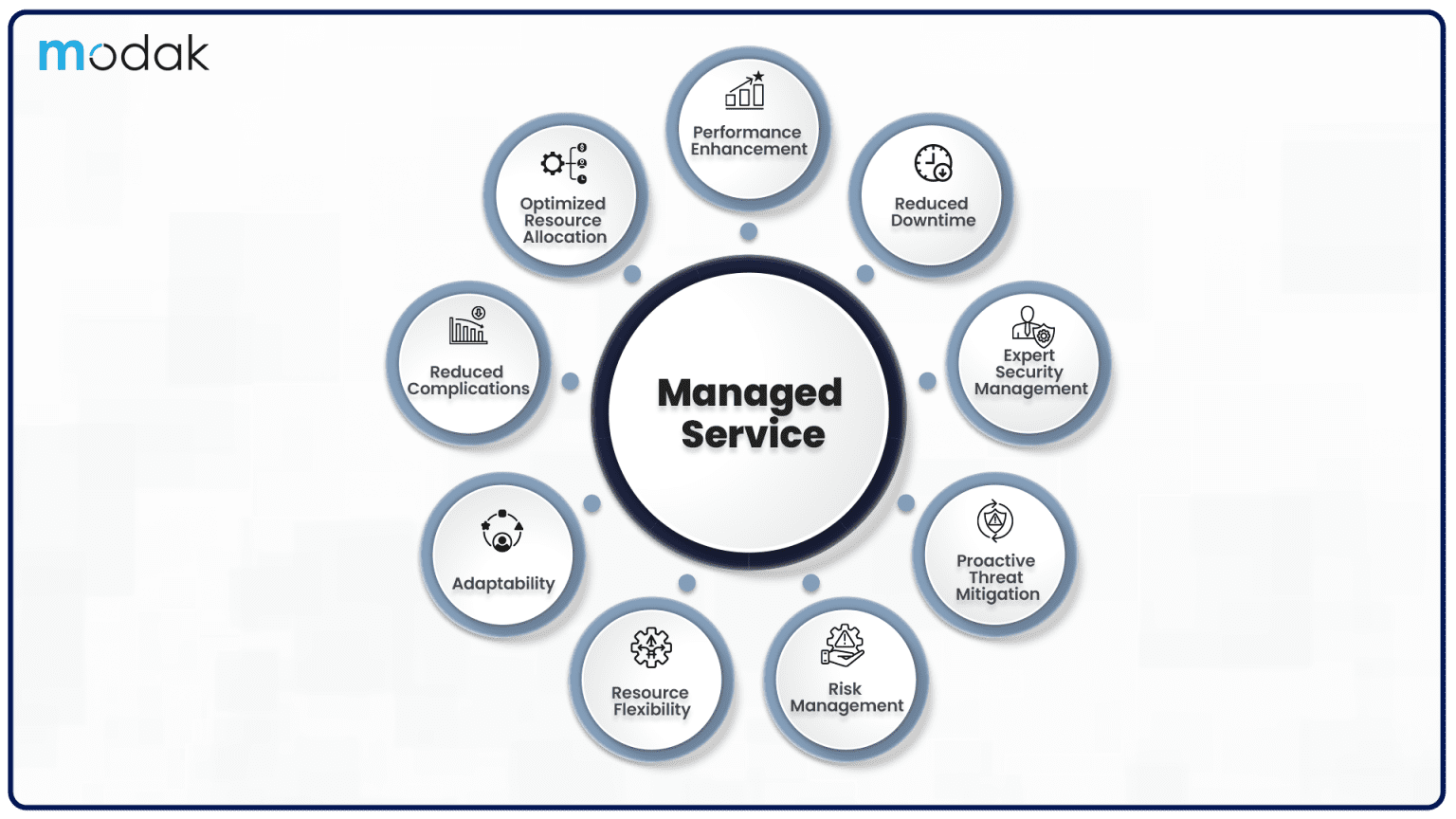
Key Aspects of Managed Services:
IT Support Services: Managed IT services encompass tasks like network management, server maintenance, software updates, and helpdesk support. By outsourcing these IT functions to managed service providers, organizations can ensure improved service reliability and strengthen business operational efficiency across critical systems.
Security Management: Security-focused MSPs deliver threat detection, vulnerability management, and continuous monitoring—and essential capabilities for organizations operating in regulated or high-availability environments.
Infrastructure Management: Managing and maintaining an organization's infrastructure can be complex and resource intensive. Managed IT infrastructure management services can handle tasks such as data center management, cloud computing, and network infrastructure upkeep.
Maintenance Management: A core characteristic of managed services is the assurance of maintaining a robust and available infrastructure, ensuring a stable environment for product deployment and enhancement. The reliability instills confidence in developers, enabling them to execute more frequent deployments. With the burden of infrastructure management lifted, they can focus on innovation and delivering value to users, ultimately accelerating operational efficiency in business delivery.
Impact of Managed Services on Operational Efficiency
Streamlining IT Infrastructure:
Incorporating managed services into IT infrastructure management significantly improves business operational efficiency. Let us see how:
- Optimized Resource Allocation: Managed Service Providers (MSPs) have the expertise to allocate IT resources efficiently. They can identify underutilized assets and redistribute them where needed, maximizing resource utilization.
- Performance Enhancement: MSPs continuously monitor and fine-tune IT components, such as servers, network devices, and databases. This proactive maintenance ensures optimal performance and minimizes downtime.
- Reduced Downtime: The quick identification and resolution of IT issues by MSPs lead to reduced downtime. It is critical for business continuity, as every minute of downtime can translate into lost revenue and productivity.
Enhancing Security Protocols
Security is foundational to operational efficiency:
- Expert Security Management: Managed service providers employ skilled security experts who are well-versed in the latest threats and vulnerabilities. They develop and implement robust security strategies customized to the organization's specific objectives and goals.
- Proactive Threat Mitigation: With continuous monitoring and threat detection, MSPs can identify and neutralize potential security threats before they escalate. This proactive approach prevents data breaches and cyberattacks that can disrupt operations and damage reputation.
- Risk Management: Managed security services encompass reviews, risk assessment, and compliance management. By staying ahead of regulatory requirements, organizations reduce legal and financial risks associated with non-compliance.
Improving Scalability:
The ability to scale operations efficiently is a hallmark of managed services:
- Resource Flexibility: Managed services offer on-demand access to additional resources as needed, allowing businesses to scale up or down efficiently.
- Adaptability: Managed service providers help organizations adapt to evolving market conditions and customer demands, enabling agility and competitiveness.
- Reduced Complications: Scaling operations can be complex, but managed services simplify the process, minimizing downtime.
Fostering Developer Confidence and Customer Satisfaction
The reliability of the infrastructure underpinned by managed service providers cultivates a deep sense of confidence in developers. They can confidently push their codes to production, knowing that the infrastructure will be consistently available for end users. The unwavering reliability not only supports smooth business operational efficiency but also significantly contributes to customer satisfaction. When customers can access products and services without disruptions, their trust in the business grows.
In a nutshell, managed services provide a comprehensive approach to operational efficiency, helping organizations optimize operations, boost productivity, and enhance security to thrive in today's competitive landscape.
Future Trends in Managed Services for Scaling Operational Excellence
The landscape of managed services is evolving rapidly, and future trends are poised to further enhance their role in scaling operational excellence.
Several key trends are shaping this transformation:
AI and Automation Integration
Artificial Intelligence (AI) and automation will play a pivotal role in managed services. AI-driven analytics and machine learning will enable predictive maintenance, proactive issue resolution, and dynamic resource allocation, ensuring operations remain efficient and scalable.
Enhanced Cybersecurity Services
With the growing threat landscape, managed service providers will place a greater emphasis on cybersecurity. Advanced threat detection, response capabilities, and compliance management will be integrated to safeguard data and operations.
Edge Computing Support
As edge computing gains prominence, managed services will extend to manage edge devices and infrastructure. This ensures efficient processing of data closer to the source, reducing latency and enhancing scalability.
Hybrid and Multi-Cloud Management
With businesses increasingly adopting hybrid and multi-cloud strategies, managed services will focus on unified cloud management. This approach streamlines operations, optimizes resource utilization, and ensures scalability across diverse cloud environments.
IoT Management
The Internet of Things (IoT) will see widespread adoption, and managed services will provide IoT device management, data analytics, and security solutions. This will support the scalability of IoT deployments across various industries.
Conclusion
Managed service providers have become an indispensable partner for organizations aiming to maximize operational efficienny efficiency in today's highly competitive business landscape. By streamlining IT infrastructure, enhancing security protocols, and enabling scalability, MSPs act as catalysts for innovation, agility, and customer satisfaction. The integration of technologies like Hadoop and cloud services further emphasizes their transformative potential. By leveraging the expertise of Managed Service Providers (MSPs), organizations can focus on their core objectives, reduce costs, and ensure seamless operations.
About Modak
Modak is a data and AI partner, dedicated to empowering enterprises in effectively managing and harnessing their data landscape. They offer a technology, cloud, and vendor-agnostic approach to customer datafication initiatives. Leveraging machine learning (ML) techniques, Modak revolutionizes the way both structured and unstructured data are processed, utilized, and shared.
Modak has led multiple customers in reducing their time to value by 5x through Modak’s unique combination of data accelerators, deep data engineering expertise, and delivery methodology to enable multi-year digital transformation. To learn more, visit our resources.