



Snowflake vs Redshift is no longer an architecture debate. Both separate storage from compute, both offer serverless compute, and both read Apache Iceberg. The deciding factors are cloud strategy, cost shape, and who owns operations.
Your warehouse contract is up for renewal, and the bill has moved in ways the forecast did not predict. Your AI roadmap now depends on how quickly governed data reaches models. A board member has asked whether you chose the right platform three years ago.
Most comparison content on AWS Redshift vs Snowflake was written for a different market. It frames the choice as coupled clusters against decoupled compute, manual tuning against automation, single cloud against multi-cloud. Those distinctions were real in 2020. In 2026, several have collapsed.
Why Snowflake vs Redshift Is a Different Question in 2026
Four shifts changed the decision:
1. Redshift closed the architecture gap
RA3 nodes and Serverless both use Redshift Managed Storage, so compute and storage scale independently. On April 27, 2026, AWS made AI-driven scaling the default for new Serverless workgroups. On May 12, 2026, it released RG instances: Graviton-based provisioned nodes that AWS says run up to 2.4x faster than RA3 at 30% lower price per vCPU, with a built-in lake engine that removes Spectrum’s per-terabyte scan charges.
2. Snowflake opened its storage layer
At Summit in June 2026, Snowflake announced general availability of Apache Iceberg v3, Snowflake-managed Iceberg storage on AWS and Azure, and bidirectional read and write access for external engines through Polaris. Adaptive Compute, which removes manual warehouse sizing, was announced as moving to general availability.
3.The two vendors converged on the same cloud and the same silicon.
On May 27, 2026, Snowflake committed $6 billion over five years to AWS, covering Graviton compute and AI infrastructure. Snowflake remains multi-cloud, but AWS is where it is placing its largest bet.
4. Open table formats changed the cost of being wrong.
When both platforms read and write Iceberg, your data is less captive than it was. Your SQL, governance model and operating habits are not.
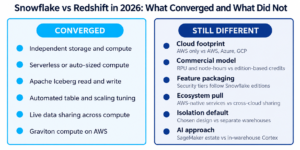
Figure 1. Snowflake vs Redshift in 2026: what converged and what still differs. Sources: AWS What’s New announcements (April to July 2026); Snowflake Summit 2026 and the May 27, 2026 press release.
What Older Snowflake vs Redshift Comparisons Still Get Wrong
Several widely read AWS Redshift vs Snowflake comparisons repeat claims that stopped being true. If your internal evaluation cites them, correct the record first.
| Older claim | 2026 position |
| Redshift distribution keys cannot be changed after table creation. | ALTER DISTKEY and ALTER SORTKEY are supported. Tables can also be set to AUTO, so Redshift applies keys as the table grows. |
| Redshift treats JSON as plain strings. | The SUPER type stores semi-structured data natively, and materialized views can shred it into columnar form. |
| Redshift ties storage to compute. | RA3, RG and Serverless use Redshift Managed Storage, and compute scales on its own. |
| Querying the lake through Spectrum gets expensive. | RG instances run a built-in lake engine with no Spectrum per-TB scan charge. RA3 clusters still pay $5 per TB scanned. |
| Snowflake keeps your data in a closed format. | Iceberg v3 tables with Snowflake-managed storage can be read and written by external engines. |
Treat vendor performance claims with the same discipline. AWS’s 2.4x compares RG with RA3. Snowflake’s quoted gains for Adaptive Compute, up to 1.6x on analytics and up to 3.5x on DML, compare it with Gen1 warehouses. Both are vendor-reported. Neither compares one platform with the other, so neither settles Snowflake vs Redshift on speed.
AWS Redshift vs Snowflake: How Each Platform Runs Day to Day
| Dimension | Amazon Redshift | Snowflake |
| Footprint | AWS only | AWS, Azure and Google Cloud |
| Compute | Provisioned RA3 or RG clusters, or Serverless billed in RPUs | Virtual warehouses (Gen1 and Gen2), with Adaptive Compute moving to GA |
| Scaling | AI-driven scaling on Serverless; concurrency scaling on provisioned | Multi-cluster warehouses on Enterprise edition and above |
| Storage | Redshift Managed Storage, plus Iceberg on S3 | Snowflake storage, plus Iceberg v3 managed or external |
| Semi-structured data | SUPER | VARIANT |
| Table design | Automatic table optimization | Micro-partitions, with optional clustering keys |
| Pipelines and ingestion | Zero-ETL from Aurora and supported applications | Openflow for data and AI pipelines |
| AI | SageMaker lakehouse and Unified Studio integration | Cortex AISQL, generally available, with models from several providers |
The practical difference is where complexity lives. Snowflake isolates workloads by default: separate warehouses read the same data. That default makes cost sprawl easy, because every team can create compute. Redshift gives you more explicit choices, from provisioned or Serverless to multi-warehouse data sharing. Its federated permissions define row, column and masking policy once and enforce it across the warehouses in an account. You get tighter cost control if your team uses those choices, and more decisions to make if it does not.
Neither platform is the more automated one anymore. Redshift automates table design and scaling. Snowflake still asks you to size warehouses until Adaptive Compute reaches your account. Early analyst commentary cautions that Adaptive warehouses bill per query and can raise spend, because each query is sized for performance rather than for cost.
Amazon Redshift Pricing and Snowflake Pricing: Compare Cost Shape, Not Rate Cards
List prices are public, so every comparison quotes them. They rarely decide the outcome. The rates below are US East list rates on AWS at the time of writing. Confirm them against each vendor’s current price sheet before you model.
| Item | Amazon Redshift | Snowflake |
| Compute unit | RPU-hour (Serverless) or node-hour (RA3, RG) | Credit |
| List rate | $0.375 per RPU-hour | About $2, $3 and $4 per credit on Standard, Enterprise and Business Critical |
| Billing | Per second, 60-second minimum (Serverless) | Per second, 60-second minimum |
| Storage | $0.024 per GB-month, about $24 per TB | About $23 per TB-month on capacity contracts; on-demand has been listed at $40 |
| Discounts | 1- and 3-year Reserved Instances on provisioned | Pre-purchased capacity |
| Idle compute | Serverless bills nothing when no queries run | Suspended warehouses bill nothing |
Amazon Redshift pricing and Snowflake pricing both look simple on a rate card. They diverge in practice for five reasons.
- The units do not convert: An RPU carries 16 GB of memory. A credit is one hour of an X-Small warehouse, and each size up doubles it. There is no honest conversion table, so only a replay of your own workload produces a comparable number.
- Utilization sets the winner: Steady, near-continuous load favors committed provisioned capacity. Bursty, multi-team load favors per-second metering with fast suspend. Both can bill nothing at idle, so the real comparison is commitment against burst.
- Edition gating moves the rate: A Snowflake credit costs 50% more on Enterprise than on Standard, and 100% more on Business Critical. Multi-cluster warehouses and 90-day Time Travel start at Enterprise. Private connectivity and Tri-Secret Secure start at Business Critical. Regulated workloads often land on the higher tiers.
- Retention multiplies storage: Time Travel and Fail-safe on high-churn Snowflake tables can add several multiples of the base table size. On Redshift RG, incremental snapshots are metered by unique blocks, not total snapshot size.
- Data movement is its own meter: Snowflake lists transfer from $20 per TB across regions to $90 per TB out to the internet or another cloud in US regions. Redshift lake queries through Spectrum on RA3 carry $5 per TB scanned.
Then run an AWS Redshift vs Snowflake bake-off that holds up:
- Replay two to four weeks of production query history, not TPC-DS.
- Include ingestion, transformation and BI refresh, not only analyst queries.
- Measure p95 latency in your peak concurrency window.
- Price each side with the commitment you would actually sign.
- Add the engineering hours each platform consumes in a quarter.
Governance and AI: The New Decision Layer
Governance now matters as much as compute in any Snowflake vs Redshift evaluation. Iceberg lets several engines touch one table, which makes access policy the new control point. Snowflake supports the Iceberg REST scan plan API so row access and column masking can carry to compatible third-party engines. Redshift federated permissions and SageMaker lakehouse access controls play the equivalent role inside AWS.
On AI, the philosophies differ. Snowflake brings models to the data: Cortex AISQL is generally available across text, documents, images, audio and video. AWS brings the warehouse into a wider ML estate: Redshift Iceberg materialized views write results as Iceberg tables that Athena, Spark and SageMaker read without copying data. If your AI work is mostly SQL-adjacent enrichment, the first fits. If it runs through a broader training and serving estate on AWS, the second does.
When AWS Redshift vs Snowflake Each Wins
Redshift tends to win when:
- Your estate is committed to AWS and your sources are Aurora, DynamoDB or S3.
- Load is steady and heavy, so Reserved Instances and RG pricing apply.
- Your team already runs IAM, VPC and AWS-native governance.
- Policy requires data to stay inside your AWS network boundaries.
Snowflake tends to win when:
- You run, or will run, more than one cloud, including estates inherited through acquisition.
- Many teams need isolated, bursty compute on shared data.
- You share data with partners or customers outside your organization.
- You want fewer operational decisions and accept edition-based pricing in return.
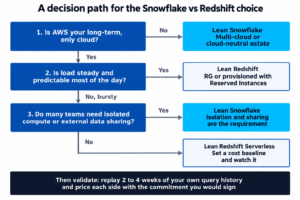 Figure 2. A decision path. It narrows the field. The final step is always a test on your own workload.
In AWS Redshift vs Snowflake evaluations, a third answer is now credible: run both on shared Iceberg tables. It is technically feasible because both platforms read and write the format. It also doubles your governance surface and your skills requirement, so it needs a named owner and a clear reason, such as a workload that is cheaper on one engine.
Migration: The Data Is Portable, the Logic Is Not
Iceberg lowers the cost of moving data. It does nothing for everything around it. Redshift SQL derives from PostgreSQL and Snowflake’s dialect differs, so stored procedures, UDFs, workload management logic, orchestration and BI semantic layers all need review. On the Redshift side, AWS stopped supporting creation of new Python UDFs on November 1, 2025, which makes existing UDF estates a migration driver in their own right. Moving the other way, VARIANT-heavy pipelines must be remapped to SUPER or flattened. Plan the move as a program with parity testing, a dual-run period and a rollback path, not as a copy job.
As a certified AWS and Snowflake partner, we implement on both platforms. That is why we treat the Snowflake vs Redshift decision as a workload question, not a loyalty question.
The Bottom Line
Choose Redshift when AWS is your strategy and your load is predictable. Choose Snowflake when cloud neutrality, isolated bursty workloads or data sharing drive the business. For most enterprises in 2026, the honest answer to Snowflake vs Redshift sits in a bake-off on your own query history, not in a feature table.
FAQs
Is Snowflake or Redshift cheaper in 2026?
It depends on utilization. Steady workloads on committed Redshift capacity, especially RG instances at 30% lower price per vCPU than RA3, tend to cost less. Bursty, multi-team workloads often suit Snowflake’s per-second credits. RPUs and credits do not convert, so replay your own query history before deciding.
Does Redshift still need manual tuning compared with Snowflake?
Much less than before. Automatic table optimization manages distribution and sort keys, and Serverless uses AI-driven scaling by default for new workgroups. Snowflake still requires warehouse sizing until Adaptive Compute reaches your account. Both platforms still reward workload-aware design.
Is Snowflake faster than Redshift?
No public benchmark settles it. AWS reports up to 2.4x gains for RG over RA3. Snowflake reports gains for Adaptive Compute over Gen1 warehouses. Each compares a platform with its own earlier generation. Data shape, concurrency and configuration decide real performance, so test your own queries.
Can Redshift and Snowflake share the same Iceberg data?
Technically yes. Redshift writes to Iceberg tables, and Snowflake supports Iceberg v3 with bidirectional access for external engines through Polaris. In practice you need one agreed catalog and one owner of access policy. Without them, two engines on one table produce governance drift.
How hard is it to migrate between Redshift and Snowflake?
Data movement is the easy part. SQL dialect differences, stored procedures, UDFs, workload management logic, orchestration and BI models need rework and parity testing. Budget for a dual-run period. Semi-structured pipelines also need mapping between SUPER and VARIANT.