




The Teradata story is increasingly framed as one of operational drag and architectural lock-in. That framing is driving renewed urgency around Teradata to Databricks migration. Databricks, by comparison, offers a story of reinvention, data-driven innovation, faster time to insight, and AI-native execution. That narrative matters to enterprises evolving toward platform-first thinking, where data and AI infrastructure are treated as core enablers of competitive advantage.
Modern data platforms are expected to deliver more than scale. They must serve as execution engines for real-time analytics, machine learning pipelines, federated governance, and AI-native applications.
A significant number of enterprises still run core workloads on Teradata, a platform engineered and, to its credit, proven over decades, for large-scale structured SQL analytics.
The question for most enterprises today isn’t whether Teradata can still process queries reliably; it clearly can, at real scale, for real businesses. The question is whether its architecture and economics are the right foundation for where AI and ML workloads are heading.
This blog lays out the architectural, operational, and economic case for data migration from Teradata to Databricks, and where Modak’s approach reduces the risk and timeline of making it happen.
Why Databricks Is Better Positioned for AI-Driven Enterprises
Teradata earned its position over more than three decades as one of the original commercial massively parallel processing (MPP) systems, it has always supported distributed query execution across nodes, and that architecture is precisely why it has scaled to some of the largest structured-data workloads in banking, telecom, and retail. That’s not in dispute, and it’s worth being precise about it, because the real gap isn’t distributed processing, it’s the kind of distributed processing.
Teradata’s architecture was built for centralized, batch-oriented, structured analytics with tightly coupled compute and storage. Teradata has since introduced cloud offerings, including VantageCloud, which decouple compute and storage to some degree and support object storage integration, so the comparison here isn’t “cloud-native vs. no cloud option” but rather how far each platform has gone in embracing elastic, open, multimodal, ML-native architecture.
On that axis, Databricks, built on Apache Spark and Delta Lake, supports batch, streaming, and interactive workloads in a single unified engine, and was designed from the outset for elastic compute and open formats rather than retrofitted toward them.
Let’s compare the two platforms across four dimensions: architecture, economics, AI readiness, and ecosystem alignment.
1. Architecture: Structured Analytics vs. Unified Multimodal Engines
Teradata remains extremely capable for structured, SQL-based analytics at scale, and many enterprises run mission-critical BI and reporting workloads on it without issue. Where it becomes constraining is multimodal and unstructured data processing, native streaming ingestion, and workloads that need to move fluidly between batch and real-time.
Databricks, built on Spark and Delta Lake, supports batch, streaming, and interactive workloads in one execution engine. Whether the use case is fraud detection, recommendation, or streaming analytics, Databricks was designed to scale those patterns natively rather than bolt them on.
For organizations Migrating Teradata to Databricks, this unified architecture simplifies modernization while creating a stronger foundation for AI and advanced analytics.
A concrete example: After 26 years on Teradata, National Australia Bank (NAB) migrated to a Databricks-powered platform to unlock real-time analytics and AI capabilities across 456 use cases. Their new platform, Ada, now supports both structured and unstructured data workloads across 12 business units.
It’s a good illustration of what re-platforming can unlock, not because Teradata couldn’t run the bank, but because the target workloads had outgrown what the original architecture was built for.
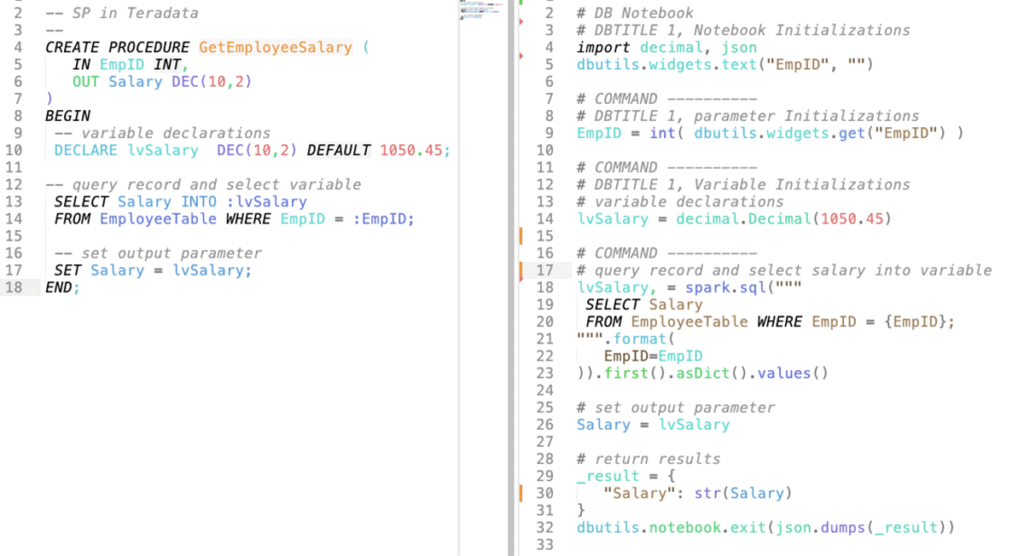
Exhibit 1: An example of a Teradata Stored Procedure converted to Databricks
2. Economics: The Business Value of Teradata to Databricks Migration
Teradata’s traditional economic model requires provisioning compute capacity in advance, with compute and storage tightly coupled in most deployment modes. This works well for predictable, steady-state workloads, but it’s inefficient for bursty AI and exploratory workloads that need short periods of high compute and long periods of near-idle usage.
Databricks offers decoupled compute and storage with consumption-based billing, which is a better match for elastic experimentation and variable AI training loads. These advantages are among the primary reasons enterprises prioritize Teradata to Databricks Migration as part of broader cloud modernization initiatives.
On cost savings claims: migration case studies, including a British professional services firm’s engagement with LTIMindtree, have reported substantial infrastructure cost reductions from automating object conversion and moving to cloud-native, elastic compute. Actual savings vary significantly by workload mix, existing utilization, and migration approach, so any specific percentage should be treated as a case-specific outcome rather than a guaranteed result, and validated against your own workload profile during a discovery phase.
3. AI and ML Readiness: Warehouse vs. Lakehouse
This is less a Teradata-specific weakness than a category difference: like most enterprise data warehouses, Teradata wasn’t built as an ML training and serving platform.
There’s no native GPU acceleration or distributed model training, and feature stores and model registries have to be managed externally, which creates integration overhead for teams building production ML.
Databricks was built with the AI/ML lifecycle in mind from an earlier point in its evolution, with native support for MLflow, Feature Store, Model Serving, and shared notebooks, giving data scientists and engineers a common environment rather than a set of stitched-together tools. This is another compelling reason enterprises undertaking Teradata to Databricks Migration are better positioned to operationalize AI initiatives faster.
4. Ecosystem Alignment: Closed Governance vs. Open Standards
As enterprises move toward data mesh and domain-oriented ownership, centralized, vertically integrated governance models become harder to extend to federated access control and cross-domain lineage. This is an area where Teradata’s traditional governance tooling is less naturally suited to hybrid-cloud, multi-domain operating models.
Databricks addresses this with Unity Catalog, a unified metadata and governance layer spanning users, clouds, and data types, with integration into cloud-native IAM systems and support for enterprise lineage.
It’s worth noting that cross-cloud governance maturity still varies by cloud provider and catalog federation setup, Unity Catalog is a strong foundation, not a fully solved problem, and organizations should validate their specific multi-cloud governance requirements during planning.
Databricks also embraces open standards, Delta, Parquet, Iceberg, allowing enterprises to interoperate with orchestration tools like Airflow, transformation frameworks like dbt, and observability platforms like Monte Carlo or Great Expectations. These capabilities further strengthen the case for data migration from Teradata to Databricks, enabling organizations to future-proof their data ecosystem.
Where the Architectural Gap Is Widest
Some workload patterns are genuinely difficult to support well on a traditional Teradata deployment without significant supplementary tooling:
- Real-time stream ingestion from Kafka or Pulsar
- Distributed deep learning pipelines with TensorFlow or PyTorch
- Notebook-native, polyglot data science environments
- Native, first-class support for open file formats and object storage at scale
- Federated policy enforcement across multi-cloud deployments
Teradata has integration options for some of these, QueryGrid, for instance, enables connections to external systems including object storage and Hadoop, but these are additive integrations rather than native capabilities, and they add operational and licensing overhead. Databricks was designed around these patterns from the start, which is a meaningful architectural difference even where Teradata can technically reach similar outcomes through additional tooling.
Related Reading: Hadoop to Databricks Migration Guide
Teradata to Databricks Migration With AI/ML at the Core
Migration isn’t a simple translation exercise. It’s a re-platforming effort that has to address performance engineering, cost restructuring, governance fidelity, and AI/ML enablement together. Success depends on more than code conversion; it requires realigning how data is processed, secured, and operationalized across the enterprise. Organizations Migrating Teradata to Databricks must therefore look beyond technical conversion and focus on building an AI-ready operating model.
Modak approaches this through automation-driven engineering and a transformation-aware delivery model, built around three technical pillars.
1. Automated Assessment of the Legacy Teradata Estate
Before any workload moves, Modak’s platform, Nabu, runs a full diagnostic of the existing Teradata environment.
Nabu is Modak’s cloud-neutral data platform for automating data engineering processes, ingestion, profiling, curation, and governance, across large-scale environments. It supports building a data fabric by integrating distributed datasets into a centralized data lake, powering data domain products aligned with data mesh principles, with built-in ingestion, data fingerprinting, dynamic tagging, active metadata cataloging, and collaborative workspaces.
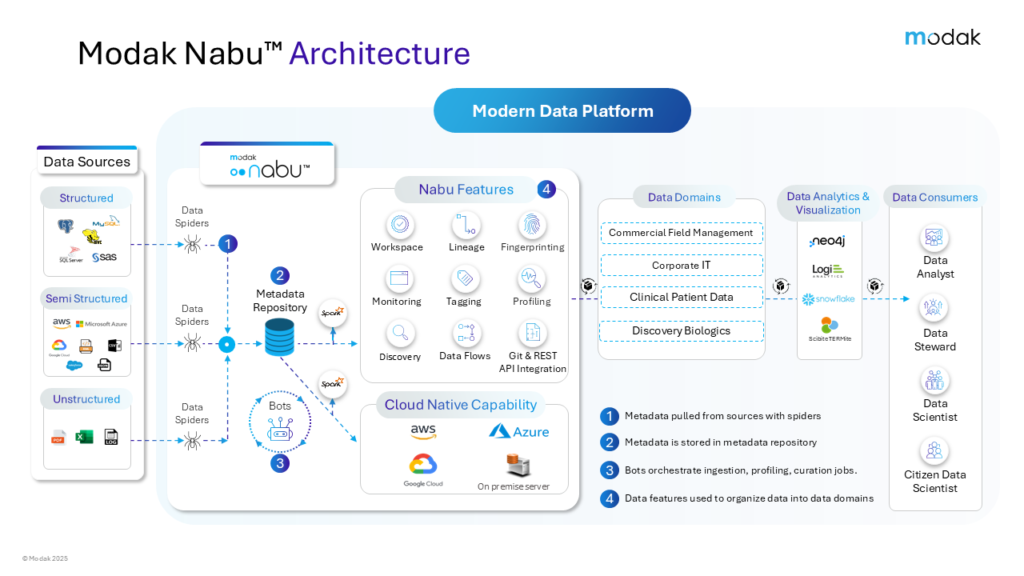
- Technical metadata extraction: Nabu connects to Teradata systems and ingests schema definitions, job schedules, stored procedures, and ETL logic, reducing reliance on tribal knowledge or manual mapping.
- Dynamic DAG construction: Dependencies between data objects, jobs, and schedules are rendered as an executable DAG, giving visibility into what’s mission-critical, redundant, or brittle.
- Business logic grouping: Pipelines are clustered by report lineage and KPI sensitivity, helping data leaders prioritize Teradata to Databricks Migration based on business impact.
This assessment step typically identifies jobs that can be decommissioned or consolidated before any code is written, reducing overall migration scope.
2. Cloud-Native Code Generation for Databricks
Once the migration blueprint is defined, Modak generates Spark-native pipelines built for the Databricks runtime.
- Pipeline generation: Teradata SQL and stored procedures are converted into modular Spark code supporting Parquet, Delta Lake, and scalable compute patterns.
- Adaptive execution plans: Jobs are instrumented with dynamic partitioning, caching, and join optimizations aligned to Databricks’ performance characteristics.
- Governance-aware design: Pipelines integrate with Unity Catalog for column-level lineage, RBAC enforcement, and audit trails.
Generated pipelines are CI/CD-ready, containerized where appropriate, and version-controlled through GitOps tooling (Azure DevOps, GitHub Actions, Jenkins), so migrated workloads become a foundation that future ML pipelines and inference endpoints can build on without rewrites.
This approach significantly accelerates data migration from Teradata to Databricks while reducing engineering effort.
3. AI/ML Platform Enablement, Not Just Pipeline Migration
Modak’s approach is designed to prepare enterprises for AI-native operations rather than stopping at warehouse replication.
- ML integration points: Pipelines are structured for reuse in MLflow and Databricks Feature Store, embedding feature engineering into production jobs.
- GPU readiness: Pipelines are designed to offload preprocessing and inference to GPU-backed clusters where needed.
- Model observability: Logging and monitoring frameworks (Datadog, Grafana, native Databricks metrics) are embedded to track drift, latency, and data quality.
The goal is for organizations to be able to extend from BI workloads to recommendation engines, forecasting, and GenAI use cases without redesigning the underlying architecture. This makes Teradata to Databricks Migration a strategic transformation rather than a one-time modernization project.
Additional Considerations for Teradata to Databricks Migration
- Job orchestration: Legacy job schedules can be translated to Airflow DAGs or Databricks Workflows, preserving sequencing logic and SLA requirements.
- Cost engineering: Pipelines are deployed with autoscaling, cluster pooling, and spot-instance fallback to optimize runtime economics, actual savings should be validated against your specific workload profile.
- Change management: Modak supports enablement across engineering, business, and governance teams, including pair programming, KPI reconciliation, and audit reporting. This ensures organizations Migrating Teradata to Databricks can accelerate adoption while minimizing operational disruption.
Commercial Model
Modak’s delivery model is structured around business outcomes rather than time-and-materials billing:
- No CAPEX: Initial discovery and diagnostic stages are owned by Modak.
- Milestone-based billing: Payment is tied to demonstrated KPIs such as job performance, SLA adherence, and cost reduction.
- Self-funding transformation: First-year TCO savings are structured to offset implementation costs where achievable, aiming to make the migration cost-neutral or accretive from Year 1, subject to the specifics of each engagement.
Platform Thinking vs. Product Thinking
Teradata remains a strong, proven product for structured analytics at scale, that’s not in question. Databricks is a more modular, extensible platform built to evolve with multimodal data, open standards, and AI-native workloads. Databricks also fosters cross-functional collaboration among data engineers, data scientists, and governance teams, and accelerates integration with the open-source ecosystems like Airflow, dbt, Delta Lake, and Great Expectations, while enabling federated governance through Unity Catalog across pipelines, models, and analytics.
For enterprises building toward data mesh architectures and AI-first strategies, Teradata to Databricks migration represents a meaningful shift in how data capabilities are built and scaled, one that’s worth evaluating on its architectural and economic merits rather than as a referendum on whether Teradata “still works.”
Start a discovery engagement with Modak, designed for executive clarity and speed to value. In a matter of weeks, you’ll receive a blueprint that maps your Teradata exit path, quantifies ROI across cost, performance, and agility, and aligns modernization with business outcomes.
Ready to get started with your Databricks transformation? Contact us to learn more.